Matobo Hills
Ancient Granite, Ancient Art
Best Time to Visit
May to September for dry, cool weather ideal for hiking and rhino tracking. November to April for lush greenery and dramatic storm photography.
Getting There
A 40-minute drive south from Bulawayo. Best accessed by private vehicle or arranged tour. Some lodges offer transfers from Bulawayo.
Region
Matabeleland South
Two Billion Years of History
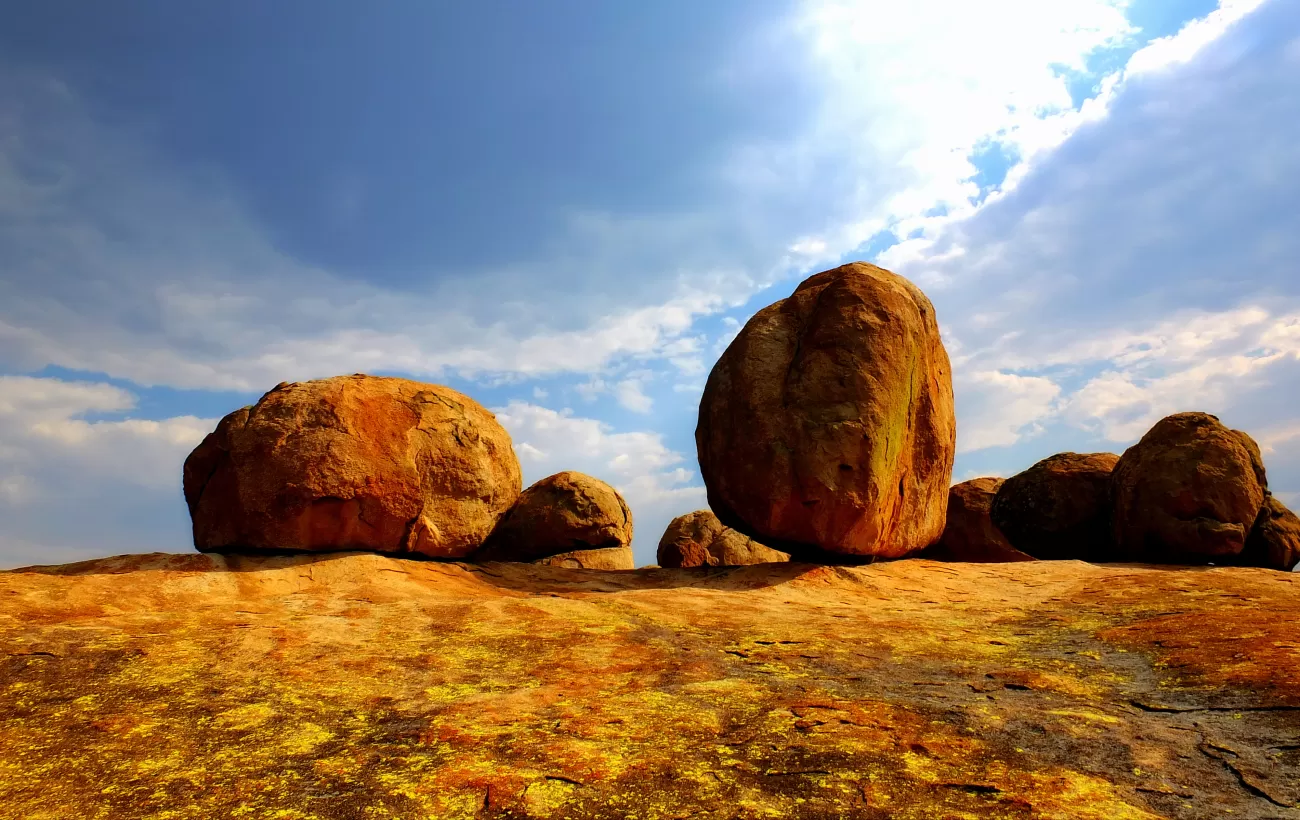
The Matobo Hills are among the oldest landforms on Earth. These granite dwalas — massive rounded boulders — were formed from magma that cooled beneath the surface over two billion years ago, long before complex life existed on this planet. Millions of years of weathering and erosion have sculpted the granite into the extraordinary landscape you see today: towering balancing rocks that seem to defy gravity, deep caves and overhangs, and castle-like kopjes rising from the surrounding savanna.
The hills cover approximately 3,100 square kilometres, of which 424 square kilometres is protected within the Matobo National Park. In 2003, UNESCO inscribed the Matobo Hills as a World Heritage Site, recognising both their outstanding natural beauty and their extraordinary cultural significance.
The Rock Art
A Gallery 13,000 Years in the Making
The Matobo Hills contain one of the highest concentrations of rock art in Southern Africa, with over 3,000 documented sites. The paintings were created by the San (Bushmen) people over a period spanning at least 13,000 years, making this one of the longest continuous artistic traditions in human history.
The paintings range from simple handprints and geometric designs to elaborate polychrome scenes depicting hunting, dancing, ritual ceremonies, and the animals that shared this landscape — giraffe, eland, kudu, elephant, and rhinoceros. Some of the finest examples can be seen at:
- Nswatugi Cave — a large, accessible cave with vivid hunting scenes and a remarkable painting of a giraffe
- Pomongwe Cave — considered one of the finest rock art sites in Zimbabwe, with layered paintings spanning thousands of years
- White Rhino Shelter — featuring a striking white rhinoceros painting alongside geometric designs
- Bambata Cave — historically significant as one of the first sites excavated by archaeologists in the early 20th century
Understanding the Art
The San rock art is not simply decorative. Many scholars believe the paintings are deeply spiritual, created by shamans to record trance experiences and communicate with the spirit world. The recurring images of eland — the San's most spiritually significant animal — and the depictions of figures in trance postures support this interpretation. Visiting with a knowledgeable guide transforms the experience from looking at faded paint to understanding a complex spiritual tradition.
Wildlife
Rhinoceros
The Whovi Game Park, a fenced wilderness area within the Matobo National Park, protects both black and white rhinoceros. Walking safaris with armed rangers provide remarkably close encounters with these magnificent animals — approaching to within 20 or 30 metres is not uncommon. For many visitors, tracking rhinos on foot through the granite hills is the highlight of their time in Zimbabwe.
Leopards
The Matobo Hills support the world's densest known population of leopards. The granite terrain provides ideal habitat — caves and overhangs for denning, rocky vantage points for ambush hunting, and abundant prey in the form of hyrax (dassies), klipspringer, and baboons. Leopards are notoriously elusive, but patient visitors on evening and early morning drives have a genuine chance of sighting these magnificent cats.
Raptors
The hills are a stronghold for Verreaux's (black) eagle, one of Africa's most powerful raptors. These eagles specialise in hunting rock hyrax and nest on the cliffs and kopjes throughout the hills. The Matobo Hills support one of the highest densities of Verreaux's eagles anywhere in their range. Other notable raptors include martial eagle, crowned eagle, Lanner falcon, and Cape vulture.
Cecil Rhodes and the View of the World
Cecil John Rhodes — one of colonial Africa's most powerful and controversial figures — first visited the Matobo Hills in 1897 during the Ndebele rebellion. He was so moved by the landscape that he chose a granite hilltop called Malindidzimu ("dwelling place of the spirits") as his burial site. He named it "The View of the World," and when he died in 1902, his body was carried by train from Cape Town to Bulawayo and then by ox-wagon into the hills.
The site offers extraordinary 360-degree views across the boulder-strewn landscape. Whether you come to reflect on Rhodes' complex legacy or simply to witness one of Southern Africa's most dramatic panoramas, the hilltop is worth the climb.
Spiritual Significance
The Matobo Hills hold deep spiritual significance for the local Ndebele people. The Njelele shrine, located within the hills, is considered one of the most important rain-making shrines in Southern Africa. To this day, communities consult the shrine's spirit medium — the Mwari — during times of drought, and visitors should be aware that certain areas within the hills are considered sacred.
When to Visit
The Matobo Hills can be visited year-round. The dry season (May to October) offers the best game viewing and most comfortable walking conditions. The wet season (November to April) brings green landscapes, dramatic skies, and excellent photography conditions, though some trails may be slippery.
The Matobo Hills have a quality that is difficult to articulate — a sense of age, of spiritual weight, of landscape that has witnessed the entire span of human existence on this continent. Standing among the granite boulders at sunset, watching Verreaux's eagles circle overhead, you understand why Rhodes wanted to rest here forever.