Few landscapes in Africa stop you in your tracks quite like Matobo Hills. Roughly 35 kilometres south of Bulawayo, this ancient wilderness of cathedral-sized granite domes, improbably balanced boulders, and shadow-filled valleys has been drawing human beings for at least 13,000 years , and it is not difficult to understand why. A UNESCO World Heritage Site since 1989, Matobo (also written Matopos) combines geological spectacle, one of the world's densest concentrations of San rock art, and some of the most rewarding wildlife encounters in southern Africa, including the rare privilege of tracking white and black rhino entirely on foot. Whether you are travelling independently from Bulawayo, joining an organised tour from Victoria Falls, or weaving Matobo into a broader road trip , as described in our guide to The Great Western Zimbabwe Road Trip: Victoria Falls to Bulawayo via Hwange and Matobo , this is a destination that rewards every hour you give it.
Quick Facts & Essential Information
Before diving into what makes Matobo so remarkable, here is the essential reference information you need to plan your visit. The national park itself covers 424 km², but the broader UNESCO-listed cultural landscape extends to approximately 3,100 km², encompassing communal land, religious sites, and private conservancies. Entry fees are collected at the main gate and are payable in US dollars cash , card facilities are unreliable throughout the park.
| Detail | Information |
|---|---|
| UNESCO Status | World Heritage Site since 1989 |
| Total landscape area | ~3,100 km² |
| National park area | 424 km² |
| Age of rock formations | ~2 billion years |
| Rock art sites identified | 3,000+ |
| Oldest known paintings | ~13,000 years old |
| Entry fee (international visitors) | ~USD $15 per person per day |
| Entry fee (SADC nationals) | ~USD $5 per person per day |
| Rhino tracking permit (additional) | ~USD $30–$50 per person |
| Distance from Bulawayo | 35 km (~45-minute drive) |
| Distance from Victoria Falls | ~440 km (~5-hour drive) |
| Park opening hours | 06:00–18:00 daily |
| Best months to visit | May–September (dry season) |
💡 Budgeting tip: Carry sufficient USD cash before entering the park. The nearest reliable ATMs are in Bulawayo. A full day including entry, a guided rock art visit, and a rhino tracking experience will typically cost USD $80–$120 per person when booked through a local operator , excellent value by any African safari standard. Browse our Business Directory for vetted local tour operators offering Matobo day trips and multi-day packages.
The Landscape: Two Billion Years in the Making
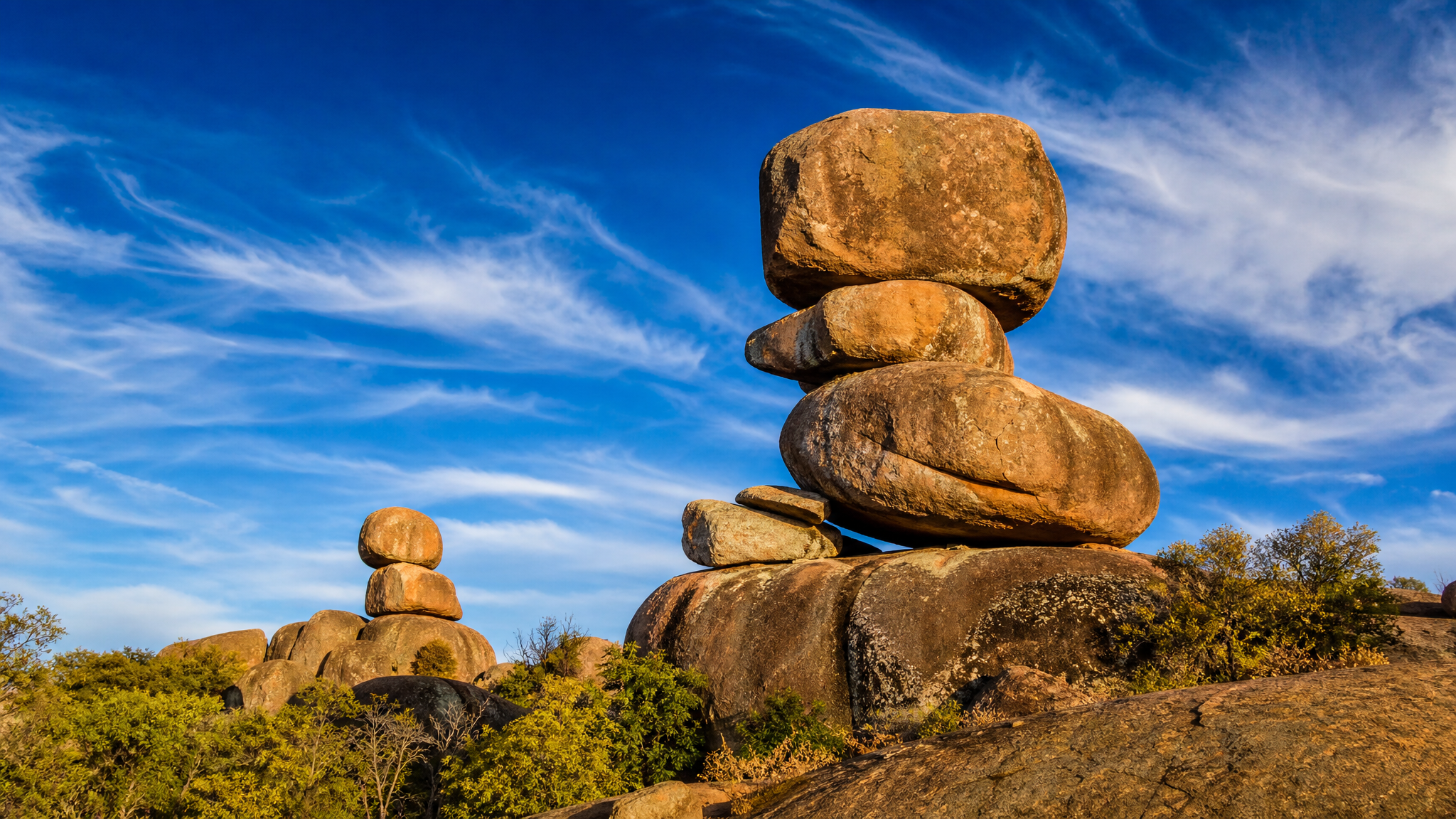
The geological story of Matobo Hills begins roughly two billion years ago, when vast bodies of molten granite slowly intruded into the earth's crust and cooled deep underground. Over the millennia that followed, the softer rock above was stripped away by erosion, exposing the granite in the extraordinary forms visible today: smooth, rounded whaleback domes (known locally as dwala), dramatic castle-like outcrops called kopjes, and the gravity-defying balancing rocks that have become one of Zimbabwe's most recognisable symbols , even appearing on the country's banknotes.
What makes the Matobo landscape feel so singular is the sheer scale and density of these formations. Driving into the park, the horizon fills with enormous domed summits stacked against one another like the backs of sleeping giants. Between them, hidden valleys shelter fig trees, euphorbias, and seasonal streams that sustain an improbable diversity of life. The Maleme Dam in the heart of the park provides a reliable water source and a beautiful focal point for wildlife watching, particularly in the dry season.
"This I call one of the views of the world." , Cecil John Rhodes, on first seeing World's View in the Matobo Hills
The summit known as World's View , where Rhodes himself is buried , remains one of the most panoramic vantage points in southern Africa, offering unobstructed views across a sea of granite domes stretching to the horizon in every direction. Sunrise and sunset here are genuinely extraordinary. The walk to the summit takes approximately 20–30 minutes from the car park and is suitable for most fitness levels, making it an ideal starting point for first-time visitors.
The hills also create their own microclimate. Higher elevations are noticeably cooler and receive slightly more rainfall than the surrounding Matabeleland plateau, which explains the pockets of lush vegetation tucked into sheltered kloofs and the remarkable biodiversity packed into a relatively compact area.
🪨 Geological note: The balancing rocks of Matobo are formed by a process called spheroidal weathering, in which water penetrates joints in the granite and preferentially weathers the corners and edges of rock blocks over millions of years, leaving rounded boulders that appear to balance precariously on one another. They are, in fact, far more stable than they look.
Rock Art: 13,000 Years of San Stories
Matobo Hills contains one of the highest concentrations of San (Bushmen) rock art anywhere in the world, with more than 3,000 sites identified across the landscape. The oldest paintings have been dated to approximately 13,000 years ago, though occupation of these shelters almost certainly predates the paintings themselves. For context, this tradition of painting continued , with extraordinary continuity , until the San were displaced from the region in the 19th century.
The paintings are executed primarily in red and white ochre, with some sites preserving remarkably vivid polychrome work. Subjects include animals , giraffe, eland, kudu, elephant, and rhino feature prominently , as well as human figures engaged in hunting, dancing, and what researchers now understand to be shamanistic trance rituals. This spiritual dimension is crucial: the paintings are not simply a record of daily life but a visual language encoding beliefs about the relationship between the physical and spirit worlds.
| Site | Highlights | Walk Difficulty | Time Needed | Guide Required? |
|---|---|---|---|---|
| Nswatugi Cave | Stunning giraffe and kudu frieze; best-preserved colours in the park | Easy (flat path) | 1–1.5 hrs | Recommended |
| Pomongwe Cave | Evidence of 40,000+ years of occupation; layered paintings spanning millennia | Easy | 1 hr | Recommended |
| Silozwane Cave | Dynamic hunting scenes; intimate knowledge of animal behaviour on display | Moderate hike | 2–3 hrs | Required |
| Bambata Cave | Major archaeological significance; some of Africa's earliest ceramic finds | Moderate | 2 hrs | Required |
| Inanke Cave | Largest single painted panel; elaborate spiritual and ceremonial scenes | Challenging | 3–4 hrs | Required |
🎨 Why a guide makes all the difference: Without interpretation, even the most spectacular paintings can seem like intriguing but opaque marks on stone. A knowledgeable guide decodes the visual language , explaining why certain animals appear in specific postures, what the lines emanating from human figures represent, and how the choice of cave itself was spiritually significant. Budget USD $20–$40 for a licensed guide; it is genuinely one of the best investments you can make at Matobo. To learn more about the broader cultural context of the region, read our piece on Discovering Ndebele Culture and Heritage in Western Zimbabwe.
For visitors combining Matobo with a wider Zimbabwe itinerary, it is worth noting that the rock art here complements rather than duplicates what you might see elsewhere. If you are arriving from Victoria Falls , where activities tend towards the adrenaline-focused, from White Water Rafting to Bungee Jumping , Matobo offers a profound counterpoint: slower, quieter, and ultimately more lasting in its impact.
Rhino Tracking on Foot
Matobo National Park is home to one of the highest densities of white rhino in the world, alongside a smaller but critically important population of the rarer black rhino. Tracking these animals entirely on foot , without the barrier of a vehicle , is widely regarded as one of the most visceral and memorable wildlife experiences available anywhere in Africa. The programme is managed with strict conservation protocols by the Matobo Rhino Trust and park rangers, ensuring both visitor safety and minimal disturbance to the animals.
A typical rhino tracking experience begins early in the morning, when rangers use radio-collar data and field knowledge to locate the rhinos' approximate position. Groups of no more than eight people then approach on foot, guided by an armed ranger and a tracker. The final approach , often through dense bush, moving slowly and silently , can take anywhere from 20 minutes to two hours depending on the rhino's location and behaviour. When you finally round a boulder or push through a thicket to find a two-tonne white rhino grazing just 15 metres away, the effect is genuinely extraordinary.
"I've done game drives across East and southern Africa for twenty years. Walking up to a rhino in Matobo , no fence, no vehicle, just us and this enormous animal , was the single most powerful wildlife moment I've had." , Sarah M., traveller from the UK
The experience costs approximately USD $30–$50 per person on top of the standard park entry fee, and should be booked in advance during the peak dry season months of June through September. Most Bulawayo-based tour operators can arrange this as part of a full-day Matobo itinerary. If you are planning a broader western Zimbabwe trip that includes Hwange National Park , where the focus shifts to elephant herds and Big Five game drives , our Safari Guide to Hwange National Park is essential reading for comparison.
⚠️ Important safety note: Rhino tracking is conducted under the supervision of armed, professional rangers and is considered safe when guidelines are followed. Visitors must remain in a tight group, move quietly, and follow all ranger instructions immediately and without question. Children under the age of 12 are generally not permitted on rhino tracking experiences. Black rhino, being more temperamental than white rhino, may require a greater safety margin and the experience may be curtailed at the ranger's discretion.
For those travelling with children or visitors who prefer a less intense wildlife encounter, the park's game drive routes around Maleme Dam offer reliable sightings of white rhino, zebra, wildebeest, giraffe, and a remarkable variety of raptors , all from the comfort of a vehicle. Check our Travel Advice pages for the latest guidance on visiting Zimbabwe's national parks safely and responsibly.
, Continued in Part 2, covering wildlife, hiking, history, accommodation, and practical planning tips ,
Wildlife and Rhino Tracking in Matobo
Matobo Hills is one of the finest places in Africa to encounter both white and black rhinoceros on foot. The Matobo National Park's intensive protection programme has made it a cornerstone of Zimbabwe's rhino conservation efforts, and guided rhino tracking walks are among the most exhilarating wildlife experiences the country offers.
Tracking is conducted on foot with armed rangers and experienced guides who read the landscape with extraordinary skill , identifying fresh spoor, crushed vegetation, and dung to locate animals that can be extraordinarily elusive despite their size. Encounters typically last 15 to 30 minutes and take place at a respectful distance of around 30 to 50 metres. The experience is raw, quiet, and deeply moving.
Beyond rhinos, Matobo supports a rich diversity of wildlife. Leopards are present in healthy numbers and are occasionally spotted at dusk near rocky outcrops. Sable antelope, zebra, giraffe, wildebeest, and impala roam the southern sections of the park, while the kopjes teem with klipspringer and rock hyrax. The area is also renowned as one of the world's highest densities of Verreaux's eagle , sometimes called the black eagle , which nests in the granite cliffs.
Game drives within the national park are available for self-drive visitors with a 4WD vehicle, or can be arranged through lodges such as Big Cave Camp and Amalinda Lodge. For those combining Matobo with broader Zimbabwe wildlife travel, our Safari Guide to Hwange National Park outlines how to track the Big Five just a few hours north, and the Hwange National Park destination page covers essential planning details.
| Season | Months | Wildlife Highlights | Conditions |
|---|---|---|---|
| Dry Season (Peak) | May – October | Rhino, leopard, sable, eagle nesting | Excellent visibility, sparse vegetation |
| Early Wet Season | November – December | Migratory birds arrive, newborn antelope | Lush but tracks can be muddy |
| Wet Season | January – March | Birdlife peaks, green scenery | Some tracks impassable, fewer visitors |
| Transition | April | Good all-round wildlife, quiet park | Tracks drying, excellent photography light |
Hiking, Rock Art, and Sacred Sites
The granite kopjes of Matobo contain one of the highest concentrations of San Bushman rock art in the world, with over 3,000 recorded sites across the broader Matobo Hills region. These paintings , rendered in ochre, white, and black pigments , depict hunting scenes, spiritual ceremonies, therianthropic figures, and a rich symbolic language that scholars are still working to fully interpret. They are believed to span a period from 2,000 to over 13,000 years old.
The two most accessible and visually stunning sites are White Rhino Shelter and Nswatugi Cave. White Rhino Shelter features a remarkable frieze of animals including the eponymous white rhino painted in extraordinary detail. Nswatugi Cave contains one of the largest collections of paintings in the region, with giraffe, kudu, and human figures arranged across a broad overhang. Both require a short walk of 20 to 45 minutes from the nearest car park.
Beyond rock art, the hills offer excellent hiking across a network of informal trails. The World's View walk , the same hilltop where Cecil Rhodes is buried , takes around 45 minutes return and rewards with sweeping panoramas across the boulder-strewn landscape. More ambitious hikers can arrange full-day guided walks with local operators, covering 12 to 18 kilometres through remote sections of the park.
Matobo is also deeply sacred to the Ndebele people, who regard the hills as the resting place of ancestral spirits. The grave of King Mzilikazi, founder of the Ndebele nation, lies within the hills and remains a site of cultural pilgrimage. To understand this heritage more deeply, read our dedicated article on Ndebele Culture and Heritage in Western Zimbabwe.
Practical Planning: Getting There, Costs, and Where to Stay
Matobo Hills lies approximately 35 kilometres south of Bulawayo, Zimbabwe's second city and the cultural capital of Matabeleland. The drive from Bulawayo takes around 45 minutes on a tarred road that is generally in good condition. Most visitors base themselves in Bulawayo and make day trips into the park, though staying within or adjacent to the park boundary is strongly recommended for early morning wildlife activities.
Bulawayo is connected to Victoria Falls by road (approximately 440 kilometres) and by the historic Bulawayo–Victoria Falls railway line. For those driving the scenic route, our guide to The Great Western Zimbabwe Road Trip covers the full journey via Hwange with practical stops and timing advice. Flights from Harare to Bulawayo Joshua Mqabuko Nkomo International Airport operate daily with Fastjet and Air Zimbabwe.
| Property | Type | Approx. Price (per night) | Best For |
|---|---|---|---|
| Amalinda Lodge | Luxury lodge | USD $350–$500 (all-inclusive) | Couples, special occasions |
| Big Cave Camp | Mid-range safari camp | USD $150–$250 (half-board) | Wildlife focus, guided activities |
| Maleme Rest Camp (ZimParks) | Self-catering chalets | USD $30–$60 | Budget travellers, self-drive |
| Bulawayo City Hotels | Hotel (day trip base) | USD $50–$120 | Business travellers, backpackers |
For broader trip planning across the region , including visas, currency, health requirements, and internal transport , our comprehensive resource Planning Your Trip to Western Zimbabwe covers everything you need before you arrive. You can also use our interactive Trip Planner to build a personalised itinerary combining Matobo with Victoria Falls and Hwange.
Combining Matobo with Victoria Falls: Building the Perfect Itinerary
Matobo Hills is most commonly visited as part of a broader western Zimbabwe circuit that includes Victoria Falls and Hwange National Park. This triangle of destinations represents some of the finest and most varied travel experiences in southern Africa, and combining them into a single trip of seven to fourteen days is entirely achievable with thoughtful planning.
A suggested routing for a ten-day trip would be: arrive Victoria Falls (days 1–3), travel to Hwange (days 4–5), continue to Bulawayo and Matobo (days 6–8), then return to Victoria Falls or fly from Bulawayo. This circuit can be driven in a reliable 4WD or completed using a combination of transfers and domestic flights.
At Victoria Falls, the activity options are extraordinary , from the thundering viewpoints of the falls themselves to adrenaline pursuits such as White Water Rafting, Bungee Jumping, Helicopter Flights, and the legendary Devil's Pool. For a complete overview, read our Complete Guide to Victoria Falls or the Ultimate Guide to Victoria Falls. If you are planning where to rest after your adventures, Where to Stay and Eat in Victoria Falls Town covers the full range of accommodation and dining options.
Travellers seeking even more off-the-beaten-path experiences might consider extending the circuit to include Binga on Lake Kariba, or the remote communal lands around Tsholotsho. Our Travel Advice section provides up-to-date guidance on road conditions, safety, and seasonal considerations across the region. For specific enquiries, do not hesitate to Contact Us directly.
Final Thoughts
Matobo Hills is one of those rare destinations that defies easy categorisation. It is simultaneously a wildlife sanctuary, an open-air gallery of ancient human expression, a place of profound spiritual significance, and a landscape of almost surreal geological beauty. Whether you come to track rhinos through golden grass at dawn, to stand in the shadow of a 13,000-year-old painting, or simply to sit atop a granite kopje and watch the sun sink behind the boulders, Matobo will leave a mark that stays with you long after you have left Zimbabwe.
What makes Matobo particularly special is the intimacy of the experience. Unlike the great plains of East Africa, where distances are vast and wildlife can feel remote, Matobo places you directly inside the landscape. You walk where the San walked. You breathe the same air as the rhinos. You feel the warmth of the same granite that has witnessed thousands of years of human history. It is a place that rewards slowness, curiosity, and a willingness to look closely.
Plan your visit carefully , choose the dry season for the best wildlife encounters, book your rhino tracking in advance, and allow at least two full days within the park to do it justice. Pair your visit with Victoria Falls and Hwange National Park for a western Zimbabwe journey that will rank among the finest wildlife and heritage trips in Africa. The Matobo Hills destination page on our site has further planning resources, operator listings, and up-to-date park information to help you prepare.
Zimbabwe's UNESCO wilderness is waiting. Go slowly, go respectfully, and go soon.
Frequently Asked Questions
When is the best time to visit Matobo Hills?
The dry season from May to October is widely considered the best time to visit Matobo Hills. Vegetation is sparse, wildlife congregates around water sources, and rhino tracking conditions are optimal. July and August offer the most reliable game viewing. The wet season (November to April) brings lush scenery and superb birdlife but can make some tracks impassable.
How do I book a rhino tracking experience in Matobo?
Rhino tracking walks can be booked directly through the Zimbabwe Parks and Wildlife Management Authority (ZimParks) office at Maleme Camp inside the park, or arranged through your lodge the evening before. Walks depart at approximately 06:00. Costs are around USD $30–$50 per person including a guide and armed ranger. Pre-booking is strongly advised during peak season (June–September).
Is Matobo Hills safe for independent travellers?
Yes, Matobo Hills is generally considered safe for independent and self-drive travellers. The national park is well-managed and ranger presence is consistent. Standard precautions apply , inform your accommodation of your plans, carry sufficient water, and do not approach wildlife on foot without a qualified guide. The roads from Bulawayo to the park entrance are tarred and in reasonable condition.
How far is Matobo Hills from Victoria Falls?
Matobo Hills is approximately 440 kilometres from Victoria Falls by road, typically a five to six hour drive via Hwange or the direct Bulawayo highway. Many visitors combine both destinations on a western Zimbabwe circuit. Domestic flights between Victoria Falls and Bulawayo take around one hour and operate daily, making the combination straightforward even on tighter schedules.