Western Zimbabwe is one of Africa's most photogenic regions, a landscape of thundering waterfalls, golden savannahs, ancient granite hills, and wildlife-rich floodplains that rewards every level of photographer, from smartphone snappers to seasoned professionals with full-frame kits. Whether you're standing on the spray-soaked rim of Victoria Falls or waiting in silence for an elephant herd to cross a waterhole in Hwange National Park, the photographic opportunities here are genuinely world-class. This guide covers everything you need to capture the region at its best: the finest viewpoints, the ideal light conditions at different times of day, safari camera settings, drone regulations, waterproof gear recommendations, night photography including the legendary moonbow, and practical tips for storing your images safely on the road. Pack your batteries, bring extra memory cards, and read on, your best wildlife and landscape shots are waiting.
Victoria Falls: Best Viewpoints & Light Direction by Time of Day
Victoria Falls offers more than a dozen distinct viewpoints, each delivering a different perspective on the 1,708-metre-wide curtain of water that drops up to 108 metres into the Batoka Gorge. Understanding where the light falls, and when, is the single most important factor in bringing home exceptional images rather than blown-out, hazy shots dominated by spray.
The Falls face predominantly north, which means the sun arcs across the south and east during the morning before swinging west in the afternoon. This creates dramatically different lighting conditions depending on which section of the viewing path you're standing on. The eastern viewpoints (near the Danger Point and Cataract Island end) receive warm front-lighting in the early morning, making them ideal for the first two hours after sunrise. The central Main Falls viewpoint is best approached between 08:00 and 10:00, when the sun is high enough to clear the gorge rim but not yet harsh. The western Devil's Cataract section, closest to the Zimbabwe–Zambia border, catches beautiful late-afternoon sidelight from around 15:30 onwards.
Spray is the great wildcard at Victoria Falls. During peak flood season (February–May), the mist can rise 400 metres into the air and completely obscure the falls themselves. Paradoxically, this spray also creates extraordinary rainbow conditions. Outside flood season (August–November), visibility is far superior and you'll see more rock face, but the volume of water is reduced. Many photographers consider October and November the sweet spot: enough water for drama, clear enough skies for sharp images, and the surrounding mopane woodland turning lush and green.
"I visited in September and the light at the Main Falls viewpoint at 07:30 was absolutely magical, warm, golden, and the rainbows were perfectly positioned. I didn't need a single filter.", Claire M., travel photographer, Bristol
Entry to the Zimbabwean side of the Falls costs USD $30 per person (2025 rate), and your ticket allows re-entry throughout the day, a smart policy to exploit, since you can shoot the morning light, return to your accommodation during the harsh midday hours, and come back for the golden-hour session. For a dramatic aerial perspective, Helicopter Flights over the Falls offer unobstructed shooting angles that no ground-level viewpoint can match, typically priced from USD $150–$185 for a 12-minute flight.
| Viewpoint | Best Time | Light Direction | Spray Level | Rainbow Potential |
|---|---|---|---|---|
| Cataract Island / Eastern End | 06:30–09:00 | Front-lit (warm morning sun) | Moderate–High | Excellent (morning) |
| Main Falls Viewpoint | 08:00–10:30 | Front to side-lit | High (flood season) | Very High |
| Danger Point | 07:00–09:30 | Side-lit | Very High | High |
| Livingstone Island / Devil's Pool | 08:00–11:00 | Overhead / front-lit | Low–Moderate | Moderate |
| Devil's Cataract | 15:30–18:00 | Warm sidelight (west) | Low–Moderate | Moderate (afternoon) |
| Helicopter / Aerial | 07:00–09:00 or 16:00–18:00 | Variable / overhead | None | Excellent (if angled) |
Tip: Bring a polarising filter to cut through spray haze and saturate the greens of the rainforest fringe. A circular polariser is particularly effective at the Main Falls viewpoint between 09:00 and 11:00, when the sun angle is ideal for polarisation to work at maximum efficiency.
Safari Photography Settings for Different Animals
Safari photography in Zimbabwe demands fast reflexes and pre-configured camera profiles, wildlife doesn't wait for you to scroll through menus. The golden rule is to set your camera before you spot the animal, not after. Here's how to approach the most common subjects you'll encounter on Game Drives in Hwange and across the broader western Zimbabwe wilderness.
For large, slower-moving animals, elephant, buffalo, white rhino, hippo, a shutter speed of 1/400s to 1/800s is generally sufficient to freeze motion. Use aperture-priority mode (Av/A) and set your aperture between f/5.6 and f/8 to keep the animal sharp while gently separating it from the background. ISO should be set to Auto with a maximum cap of ISO 3200 on modern mirrorless systems. Elephants in particular reward patience: wait for the moment a trunk curls, a calf tucks under its mother, or the herd pauses at a waterhole, these behavioural shots are far more compelling than simple profile portraits.
For fast-moving predators and birds in flight, lion on the chase, wild dog, raptors, African fish eagle, switch to shutter priority (Tv/S) and set a minimum of 1/1600s, ideally 1/2500s for birds. Use continuous autofocus (AI Servo on Canon, AF-C on Nikon and Sony) with a wide tracking zone. Burst mode at 10+ frames per second dramatically improves your keeper rate during action sequences. Don't forget to check your Zimbabwe Safari Packing List includes a sturdy bean bag or window mount, a tripod is rarely practical in a moving vehicle.
For nocturnal and low-light situations, leopard at dusk, hyena on night drives, push ISO to 6400–12800 and open your aperture as wide as it will go (f/2.8 or wider if possible). A 70–200mm f/2.8 lens is the single most versatile safari lens available, covering portraits through to moderate action at a manageable size and weight.
| Animal Type | Shutter Speed | Aperture | ISO (Auto Max) | AF Mode | Drive Mode |
|---|---|---|---|---|---|
| Elephant / Buffalo / Hippo | 1/400–1/800s | f/5.6–f/8 | 3200 | Single or Tracking | Single / Low Burst |
| Lion (resting) | 1/250–1/500s | f/4–f/6.3 | 1600 | Single Point | Single |
| Lion / Wild Dog (action) | 1/1600–1/3200s | f/4–f/5.6 | 6400 | Continuous Tracking | High Burst (10+ fps) |
| Birds in Flight | 1/2000–1/4000s | f/5.6–f/7.1 | 3200 | Continuous Wide Zone | High Burst |
| Leopard / Nocturnal | 1/250–1/500s | f/2.8 | 12800 | Single / Eye-AF | Single / Low Burst |
| Reptiles / Close-up | 1/200–1/400s | f/8–f/11 | 800 | Single Point (manual) | Single |
Lens guide: A 100–400mm or 150–600mm zoom is ideal for wildlife at distance. Carry a 24–70mm or 16–35mm for landscapes and camp scenes. A 50mm or 85mm prime at f/1.8 is excellent for environmental portraits and low-light work at lodges.
Drone Regulations in Zimbabwe: What You Must Know
Flying a drone in Zimbabwe requires advance permission from the Civil Aviation Authority of Zimbabwe (CAAZ), this is not a destination where you can simply unpack your DJI at the Falls and start filming. Penalties for unauthorised drone operation include confiscation of equipment and significant fines, so understanding the rules before you travel is essential. Before anything else, make sure your broader travel documentation is in order, our Zimbabwe Visa Guide covers entry requirements in full.
To fly legally, you must apply to the CAAZ for a Remotely Piloted Aircraft System (RPAS) operator certificate. Applications should be submitted at least four to six weeks before your trip, as processing times vary. You will need to provide proof of drone insurance, your intended flight areas, and a copy of your passport. The application fee is approximately USD $50–$100 depending on the category of operation. Commercial drone use (i.e., footage you intend to sell or publish) requires a separate commercial permit and is more involved.
Even with a valid permit, there are strict no-fly zones that cannot be overridden. These include:
- Victoria Falls National Park and the immediate gorge area
- Within 5km of any international airport (including Victoria Falls Airport)
- Over national parks without specific ZPWMA (Zimbabwe Parks and Wildlife Management Authority) approval
- Over populated areas, roads, and government buildings
- Above 120 metres (400 feet) altitude
In practice, this means that the iconic aerial shots of the Falls you see in travel magazines are almost always captured from chartered helicopters or microlight aircraft, not consumer drones. If aerial photography is a priority for your trip, budget for a helicopter flight, it is the legal, safe, and frankly more spectacular option. Always check the latest CAAZ guidelines at caaz.co.zw before your departure, as regulations are updated periodically.
Warning: Attempting to fly a drone at Victoria Falls without authorisation is a serious offence. Zimbabwean authorities actively monitor the gorge area, and several tourists have had equipment permanently confiscated. Do not risk it, the helicopter alternative produces superior images anyway.
Waterproof Camera Gear for the Falls
At Victoria Falls, your camera will get wet, the only question is how wet. During flood season (February–May), the spray at the Main Falls viewpoint is so intense that even with a rain cover, you'll be soaked to the skin within minutes. Protecting your gear is not optional; it is a fundamental part of planning your Victoria Falls photography session.
The most practical solution for dedicated camera systems is a high-quality rain cover such as the Think Tank Hydrophobia (from approximately USD $70–$120) or the Lowepro DryCover. These slip over your camera and lens and allow you to operate all controls while keeping the elements out. They are far superior to the plastic bag solutions that many travellers improvise. For lenses, check your manufacturer's weather-sealing rating: Canon L-series, Nikon Z-series, and Sony G-Master lenses all offer meaningful splash resistance, though none are truly waterproof without a housing.
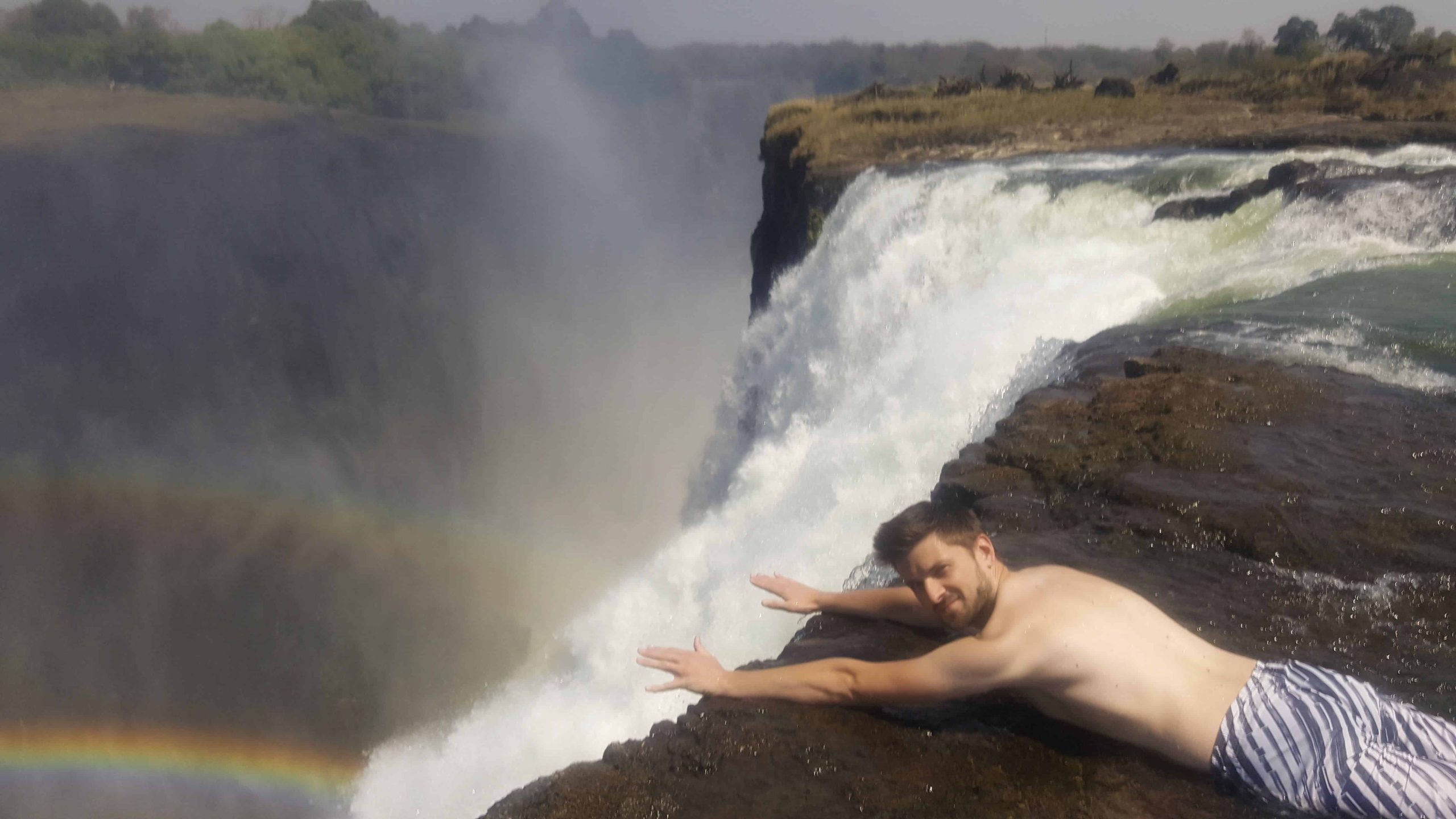
If you plan to visit Devil's Pool on Livingstone Island, the extraordinary natural infinity pool at the very lip of the Falls, a fully waterproof camera or underwater housing is essential. The Sony RX100 VII (around USD $1,150) with an underwater housing is a popular compact choice among serious photographers, while the GoPro Hero 12 Black (USD $350–$400) offers excellent waterproofing to 10 metres out of the box and produces surprisingly cinematic footage. Our full guide to Devil's Pool at Victoria Falls has more detail on what to expect from the experience itself.
For smartphone users, a waterproof case such as the Catalyst or Hitcase provides solid protection for iPhone and Samsung Galaxy models. Alternatively, many photographers carry a dry bag (from USD $15) to protect their main kit between shots, pulling it out only when ready to compose. Always carry a microfibre cloth, lens cleaning in spray conditions is a near-constant task.
"I went through three microfibre cloths in a single morning at the Main Falls. The spray is relentless in April, but the light through the mist is extraordinary, unlike anything I've photographed anywhere in the world.", James O., wildlife photographer, Edinburgh
Tip: Silica gel sachets in your camera bag will help absorb moisture after a spray-heavy session. Store them in a sealed zip-lock bag and replace them every two to three days in humid conditions. You can buy them cheaply at most pharmacies and supermarkets in Victoria Falls town.
Golden Hour Locations Across Western Zimbabwe
Golden hour in western Zimbabwe is genuinely transformative, the low-angle light turns termite mounds into sculptures, elephant skin into burnished copper, and the Zambezi River into a ribbon of liquid gold. Knowing exactly where to position yourself in the final 60–90 minutes before sunset (and the first 60 minutes after sunrise) is what separates memorable images from ordinary holiday snaps.
At Victoria Falls, the Zambezi River upstream of the Falls is the premier golden-hour location. The river runs roughly east–west at this point, meaning the setting sun lights up the water and the islands beautifully. A Sunset Cruise on the Zambezi puts you on the water during peak light, with hippos, crocodiles, and elephants drinking at the banks as the sky turns amber. Cruises depart from the Royal Livingstone jetty area and typically cost USD $45–$75 per person including drinks. Our detailed guide to the Zambezi Sunset Cruise covers what to expect in full.
In Hwange National Park, the waterholes around Main Camp and Nyamandhlovu Pan are exceptional at golden hour. The pan has an elevated viewing platform that places you above the action, giving a clear sightline across the water as elephant herds arrive to drink in the last light. The drive from Main Camp to Nyamandhlovu Pan is approximately 12km and takes around 25 minutes on the dirt track, depart at least 90 minutes before sunset to allow time for wildlife encounters en route.
In the Matobo Hills, the granite domes and balancing rock formations create extraordinary silhouette opportunities at both ends of the day. World's View, the hilltop grave site of Cecil Rhodes, offers a 360-degree panorama across the boulder-strewn landscape that is particularly dramatic at sunrise, when mist often lingers in the valleys below. If you're combining photography with cultural exploration, the Matobo Hills Rock Art sites are also beautifully lit in the low-angle morning light, which rakes across the painted surfaces and brings out the ochre and white pigments with extraordinary clarity.
Along Lake Kariba near Binga, the combination of dead trees rising from the water, vast skies, and the silhouettes of fishing boats creates some of the most atmospheric sunset photography in all of Zimbabwe. The lake's sheer scale, 226km long and up to 40km wide, means you'll rarely have a cluttered foreground, and the reflections on calm evenings are mirror-perfect. Read our guide to Lake Kariba's Houseboat Adventures for accommodation options that put you on the water at the best possible time of day.
Night Photography: Moonbows, Stars & Long Exposures
Western Zimbabwe offers some of the most extraordinary night photography opportunities on the African continent. The combination of low light pollution, dramatic landscapes, and the unique phenomenon of the Victoria Falls moonbow creates conditions that photographers travel thousands of miles to experience.
The moonbow, a rainbow produced by moonlight rather than sunlight, appears at Victoria Falls on clear nights when the moon is full or nearly full. Unlike a daytime rainbow, it appears white or pale silver to the naked eye but registers in full colour on long-exposure photographs. The best viewing position is from the Zambian side's Knife Edge Bridge, though the Zimbabwean Main Falls viewpoint also delivers striking results. Aim for a 20–30 second exposure at f/2.8 or wider, with ISO between 800 and 3200 depending on your camera's noise performance.
For Milky Way photography, the areas around Hwange National Park and Matobo Hills offer exceptional dark skies. The granite domes of Matobo provide natural foreground interest for wide-angle compositions. Use a 14–24mm lens, f/1.8–2.8, ISO 3200–6400, and apply the 500 Rule (divide 500 by your focal length) to determine maximum shutter speed before star trails appear.
Hwange's floodlit waterholes, particularly Nyamandhlovu Pan, allow for creative night wildlife photography. Some camps operate red-light setups that allow observation without disturbing animals. A 400mm f/2.8 lens with a monopod and high ISO capability (Sony A7S III or Canon R3 excel here) is the professional's choice, though modern mirrorless cameras at ISO 12800 produce surprisingly usable results.
Shutter Speed: 20–30 seconds | Aperture: f/2.8 | ISO: 1600–3200 | Focus: Manual, infinity | White Balance: Tungsten or 3200K | Format: RAW only
Drone Photography: Regulations, Permits & Best Flight Zones
Aerial photography transforms the scale and drama of Zimbabwe's landscapes, but drone operation is strictly regulated and requires advance planning. Ignoring the rules risks equipment confiscation, significant fines, and potential arrest, so understanding the legal framework is essential before you pack your DJI.
In Zimbabwe, all drone operators must obtain a permit from the Civil Aviation Authority of Zimbabwe (CAAZ). The application process typically takes 2–4 weeks and costs approximately USD $50–$100 depending on the duration and commercial versus recreational classification. You will also need to register the drone itself and carry proof of registration at all times.
Approved zones for drone photography include private game reserves and lodges (with landowner permission), open wilderness areas in Hwange, and sections of the Zambezi upstream from the falls. Many luxury lodges now offer drone photography sessions as part of premium packages, this is often the most legally straightforward option, as the lodge handles permits on your behalf.
For those planning a broader photography expedition, the Binga area on Lake Kariba's shores offers stunning aerial perspectives of the lake and Matusadona ranges with fewer airspace restrictions. The team at our Trip Planner can help coordinate drone permit applications alongside your broader itinerary. If you're combining drone work with a houseboat stay, read our guide to Lake Kariba: Zimbabwe's Inland Sea and the Best Houseboat Adventures for logistics and landing zones.
| Location | Permitted? | Permit Required | Approx. Cost | Notes |
|---|---|---|---|---|
| Victoria Falls National Park | ❌ No | N/A | N/A | Strictly prohibited, no exceptions |
| Hwange National Park | ⚠️ Restricted | CAAZ + Parks Board | USD $100–$200 | Research/commercial permits only |
| Private Game Reserves | ✅ Yes | CAAZ + Landowner | USD $50–$100 | Most flexible option for photographers |
| Lake Kariba / Binga | ✅ Mostly Yes | CAAZ | USD $50–$100 | Avoid dam infrastructure airspace |
| Matobo Hills (outside NP) | ✅ Yes | CAAZ | USD $50–$100 | Outstanding aerial rock formations |
| Urban Areas (Bulawayo etc.) | ⚠️ Restricted | CAAZ + Local Authority | USD $75–$150 | Avoid airports, government buildings |
Waterproof Gear, Mist Protection & Photo Storage on the Road
Victoria Falls produces a permanent microclimate of mist and spray that extends hundreds of metres from the main curtain. During peak flood season (March–May), the spray is so intense that visibility within the park drops to near zero and you will be completely soaked within minutes. Protecting your equipment is not optional, it is the difference between returning home with extraordinary images and returning with a very expensive paperweight.
The minimum protection for any camera at the falls is a rain sleeve (disposable or reusable). Professionals use dedicated underwater housings or hard-shell waterproof cases like Pelican 1510 for transport and Op/Tech rain covers for shooting. A UV filter on every lens provides an additional layer of protection against spray droplets on the front element. Keep a chamois leather or microfibre cloth inside a sealed zip-lock bag for rapid lens cleaning between shots.
Photo storage in the field requires a layered approach. Shoot to dual memory cards simultaneously where your camera supports it (most professional bodies do). Back up to a portable SSD (Samsung T7 Shield or SanDisk Extreme Pro) each evening, and upload selects to cloud storage (Google Photos, Dropbox, or Amazon Prime Photos) whenever Wi-Fi permits. Luxury lodges in Zimbabwe increasingly offer reliable Wi-Fi, though speeds vary.
| Item | Budget Option | Cost | Professional Option | Cost |
|---|---|---|---|---|
| Camera Rain Protection | Disposable rain sleeve (pack of 2) | ~£8 | Op/Tech Rainsleeve (reusable) | ~£25 |
| Camera Bag Waterproofing | Dry bag liner + cover | ~£15 | Lowepro ProTactic BP 450 AW II | ~£280 |
| Photo Storage | 2× 128GB SD cards | ~£30 | Samsung T7 Shield 2TB SSD | ~£140 |
| Lens Cleaning | Microfibre cloth + blower | ~£12 | Visible Dust sensor cleaning kit | ~£65 |
| Hard Case Transport | Generic foam-lined hard case | ~£40 | Pelican 1510 Carry-On | ~£320 |
| Lens Filter Protection | Basic UV filter | ~£15 | B+W XS-Pro UV MRC nano | ~£60–£90 |
For a complete packing checklist covering photography gear alongside clothing and safari essentials, our What to Pack for a Zimbabwe Safari & Victoria Falls: The Complete Packing List covers everything in detail. If you're visiting Matobo Hills for rock art photography, the ancient painted shelters require no flash photography, natural light and a fast 24–70mm f/2.8 lens are your best tools. Read more in our guide to Matobo Hills Rock Art: 13,000 Years of History Painted on Stone.
Smartphone Photography & Post-Processing Tips
You do not need a professional camera system to return from Zimbabwe with compelling images. Modern smartphones, particularly the iPhone 15 Pro, Samsung Galaxy S24 Ultra, and Google Pixel 8 Pro, are capable of producing print-quality results in good light, and their computational photography engines handle challenging conditions with impressive competence.
At Victoria Falls, use your smartphone's Pro or Manual mode to control shutter speed independently. For silky water effects, you will need a shutter speed of 1/4 second or slower, this requires a small tripod or GorillaPod. Many phones now include a built-in long-exposure mode (iPhone's Action Mode and Night Mode, Samsung's Pro Video). A polarising filter adapter for smartphones (available from brands like Moment) dramatically reduces glare on wet rocks and enhances colour saturation in the gorge.
For safari game drives, the telephoto capabilities of the latest flagship phones are genuinely impressive, the Pixel 8 Pro's 30× zoom and the Galaxy S24 Ultra's 100× Space Zoom produce usable wildlife shots at distances that would have required a 600mm prime lens five years ago. Burst mode is your friend for moving animals: hold the shutter button and select the sharpest frame in post.
Mobile: Adobe Lightroom Mobile (free RAW processing), Snapseed (free, excellent local adjustments), VSCO (film emulation presets)
Desktop: Adobe Lightroom Classic (industry standard), Capture One (superior colour science for wildlife), DxO PhotoLab (outstanding noise reduction for high-ISO safari shots)
Post-processing workflow matters as much as the capture itself. For Victoria Falls images, prioritise highlight recovery (the mist creates blown-out areas), shadow lifting, and careful dehaze adjustment, too much dehaze makes spray look artificial. For wildlife images, use targeted sharpening on the eyes only (masking tools in Lightroom's Detail panel), and apply noise reduction conservatively to preserve fur and feather texture.
If you're combining photography with a romantic trip, our Victoria Falls Honeymoon: The Ultimate Romantic Getaway Guide includes tips on the most photogenic couple experiences, from Sunset Cruises on the Zambezi to private Helicopter Flights over the falls. For families wanting to capture memories together, see our Victoria Falls with Kids: The Ultimate Family Adventure Guide for child-friendly photography spots where you can set up a tripod without obstructing other visitors.
Before you travel, ensure your entry documentation is in order, our Zimbabwe Visa Guide: Entry Requirements, Fees & Border Tips for 2026 covers everything you need, and our Is Zimbabwe Safe to Visit? Honest Safety Guide for Tourists in 2027 addresses common concerns so you can focus on photography rather than logistics once you arrive. For broader trip planning, the Planning a Trip to Zimbabwe in 2027: Visas, Flights, Budget, Safety & Everything You Need guide is the ideal starting point, and our Travel Advice section is updated regularly with current conditions.
Final Thoughts
Western Zimbabwe is, quite simply, one of the greatest photography destinations on Earth. Nowhere else can you stand in the spray of the world's largest waterfall at dawn, photograph a breeding herd of elephants at midday, capture a Milky Way arc over ancient granite domes at midnight, and then board a sunset cruise to photograph hippos silhouetted against an amber Zambezi sky, all within a single 24-hour period.
The key to returning home with exceptional images lies in preparation: understanding the light at each location before you arrive, carrying the right protective gear for the conditions, knowing the regulations around drone flight and national park access, and building flexibility into your itinerary so you can respond to unexpected wildlife encounters and weather windows.
Whether you're a professional wildlife photographer on assignment, a travel blogger building a portfolio, or a first-time visitor with a smartphone and a sense of wonder, Zimbabwe rewards patience, curiosity, and respect, for the wildlife, the landscape, and the communities that call this extraordinary corner of Africa home. The images you make here will not simply document a journey. They will tell stories that last a lifetime.
Ready to start planning? Use our Trip Planner to build your personalised Zimbabwe photography itinerary, browse our Business Directory for recommended photography guides and equipment hire, or Contact Us directly for bespoke advice. The light is waiting.
Frequently Asked Questions
What is the best time of year to photograph Victoria Falls?
The best time depends on your priorities. For maximum water volume and dramatic spray, visit February to May. For clearer views of the full falls curtain with less obscuring mist, September to November is ideal. April offers a balance of strong flow and occasional visibility. Moonbow photography requires a full moon between February and July when spray volume is sufficient to create the effect.
Do I need a permit to use a drone at Victoria Falls?
Yes, and drones are completely prohibited within Victoria Falls National Park itself, with no exceptions. Elsewhere in Zimbabwe, you must obtain a permit from the Civil Aviation Authority of Zimbabwe (CAAZ) before flying. The process takes 2–4 weeks and costs approximately USD $50–$100. Flying without authorisation risks fines of up to USD $5,000 and potential criminal charges. Always check current regulations before travelling.
How do I protect my camera from the spray at Victoria Falls?
At minimum, use a rain sleeve over your camera body and lens. During peak flood season, a full waterproof housing or hard-shell case is advisable for transport between viewpoints. Keep a microfibre cloth in a sealed zip-lock bag for rapid lens cleaning. A UV filter on every lens protects the front element from water damage. Hydrophobic filter coatings help water bead off rather than forming image-degrading droplets.
What camera settings should I use for wildlife photography on safari in Zimbabwe?
Use Aperture Priority (Av) mode with f/5.6–f/8 for sufficient depth of field. Set Auto ISO with a maximum of 6400–12800 and a minimum shutter speed of 1/1000s for moving animals (1/500s for stationary subjects). Enable continuous autofocus (AI Servo on Canon, AF-C on Sony/Nikon) with animal eye-detection if available. Shoot in RAW format and use burst mode for unpredictable movement during game drives.
Can I photograph the moonbow at Victoria Falls on a smartphone?
Yes, with limitations. Modern flagship smartphones (iPhone 15 Pro, Pixel 8 Pro, Samsung Galaxy S24 Ultra) can capture moonbows using Night Mode or Pro Mode with a long exposure of 15–30 seconds. You will need a tripod, even slight movement during the exposure will ruin the shot. Results will not match a dedicated mirrorless camera, but are impressive given the hardware. RAW capture mode significantly improves post-processing flexibility.
What is the best viewpoint for photographing Victoria Falls at sunrise?
The Cataract View and Main Falls viewpoints on the Zimbabwean side receive the most favourable east-facing light at sunrise, with warm golden tones illuminating the spray and gorge. Arrive at park opening (around 06:00) to secure position before other visitors arrive. The Knife Edge Bridge on the Zambian side offers a different angle with the sun rising behind you, ideal for capturing the full width of the Eastern Cataract in early morning light.