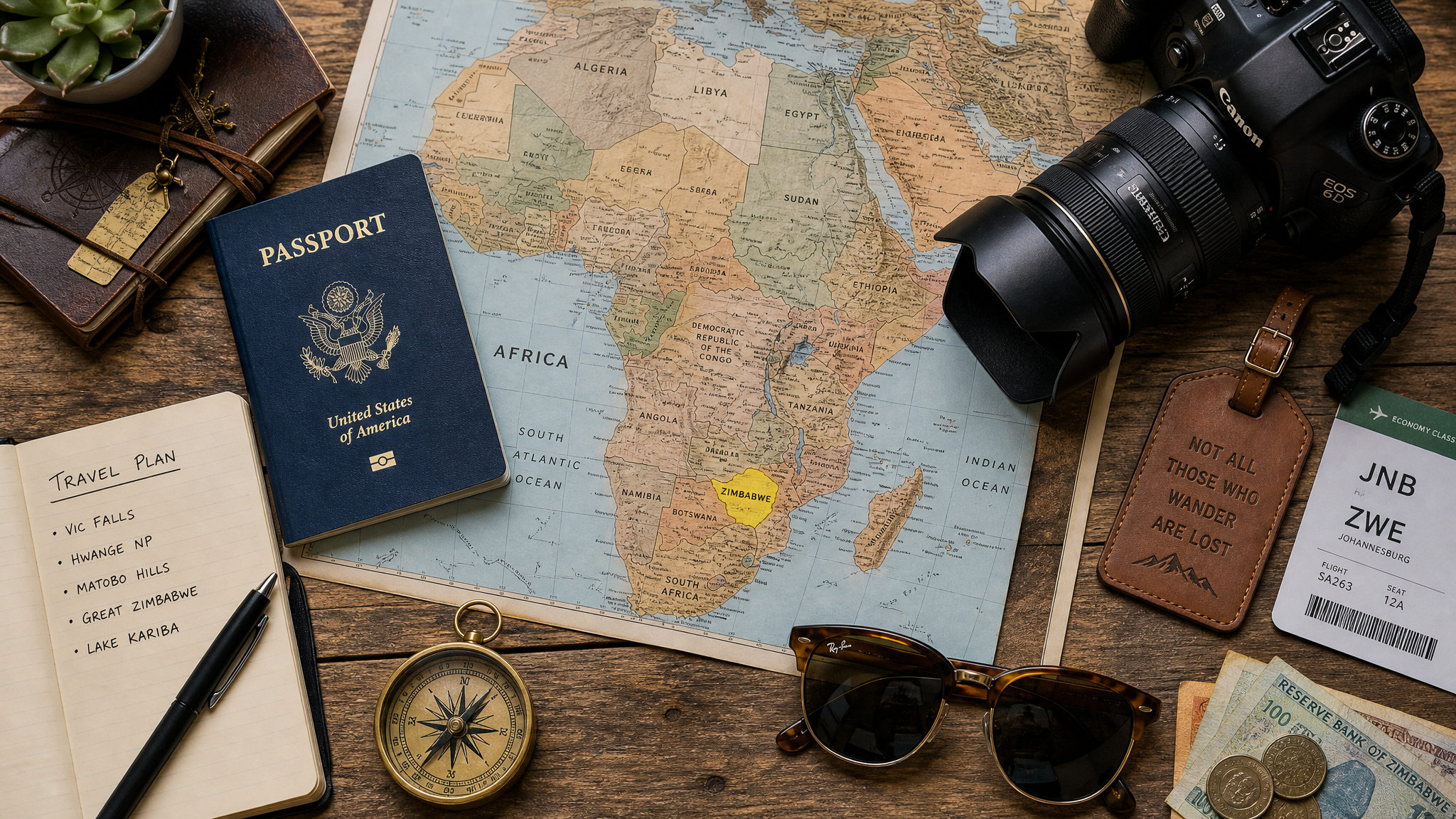
Zimbabwe in 2026 is one of Africa's most rewarding , and most underrated , travel destinations. From the thundering curtain of Victoria Falls to the ancient granite domes of Matobo Hills, the elephant-packed plains of Hwange National Park to the sun-baked shores of Lake Kariba, western Zimbabwe offers a safari and adventure experience that rivals anywhere on the continent , often at a fraction of the price. Yet planning a trip here still confuses many travellers: Which visa do I need? Is it safe? Can I use my card? Do I need malaria tablets? This definitive guide answers every one of those questions in one place, giving you everything you need to plan a confident, well-budgeted, unforgettable Zimbabwean adventure in 2026.
Visa Requirements & Entry for 2026
Most travellers to Zimbabwe require a visa, but the process is straightforward and can be completed on arrival at major ports of entry or online in advance. Zimbabwe operates three main entry options: a single-entry visa, a double-entry visa, and the highly popular KAZA UniVisa , a regional pass that is essential reading for anyone visiting both Zimbabwe and Zambia.
As of 2026, citizens of approximately 50 countries , including the United Kingdom, Germany, the United States, Australia, Canada, and most EU nations , are eligible to purchase a visa on arrival at Victoria Falls Airport, Harare International Airport, and the Victoria Falls land border. Citizens of several Southern African Development Community (SADC) nations, including South Africa, Botswana, and Mozambique, enjoy visa-free entry for stays of up to 90 days.
The KAZA UniVisa
The KAZA UniVisa costs USD $50 and grants unlimited entry between Zimbabwe and Zambia, plus day trips into Botswana via Kasane, for 30 days. It is available on arrival at Victoria Falls Airport, Harare Airport, and the Victoria Falls land border. For anyone planning a Chobe day trip from Victoria Falls or crossing into Livingstone, this is the smartest and most cost-effective option.
| Visa Type | Cost (USD) | Duration | Entries | Best For |
|---|---|---|---|---|
| Single-Entry Visa | $30 | Up to 30 days | 1 | Zimbabwe-only trips |
| Double-Entry Visa | $45 | Up to 30 days | 2 | Day trips to Zambia without KAZA |
| KAZA UniVisa | $50 | 30 days | Unlimited ZW/ZM + Botswana day trips | Zimbabwe + Zambia + Chobe visits |
| Visa-Free (SADC) | $0 | Up to 90 days | Multiple | SA, Botswana, Mozambique nationals |
| eVisa (select nationalities) | $30–$45 | Up to 30 days | Single or double | Travellers preferring pre-approval |
Tip: Always carry USD cash for visa fees at land borders and airports. Card payments for visas on arrival are not reliably accepted. Bring crisp, undamaged notes , torn or heavily marked bills are frequently refused throughout Zimbabwe.
For the most current visa eligibility information specific to your nationality, visit our Travel Advice page or consult the official Zimbabwe e-visa portal before departure. Requirements can change; always verify within 30 days of travel.
Flights, Airlines & Best Airports
Zimbabwe has two international airports of significance for tourists: Robert Gabriel Mugabe International Airport in Harare (HRE) and Victoria Falls International Airport (VFA). For travellers visiting western Zimbabwe , including Victoria Falls, Hwange, and Bulawayo , Victoria Falls Airport is the most convenient gateway, eliminating the need for lengthy overland transfers.
Victoria Falls Airport (VFA) handles direct international flights from Johannesburg (O.R. Tambo) on South African Airways and Airlink, making it easily accessible from almost any global hub with a single connection via Johannesburg. Flight time from Johannesburg to Victoria Falls is approximately 1 hour 45 minutes. Ethiopian Airlines also serves Harare with connections from Addis Ababa, providing a solid option from Europe, Asia, and North America.
From the United Kingdom, the most common routing is London Heathrow → Johannesburg (O.R. Tambo) → Victoria Falls, with a total journey time of approximately 14–17 hours including the connection. British Airways, Virgin Atlantic, and South African Airways all operate the Heathrow–Johannesburg leg. Budget-conscious travellers sometimes route via Addis Ababa on Ethiopian Airlines or via Nairobi on Kenya Airways, which can reduce fares significantly.
| Origin | Destination Airport | Airline(s) | Approx. Journey Time | Typical Return Fare (USD) |
|---|---|---|---|---|
| London (LHR) | Victoria Falls (VFA) via JNB | BA + Airlink / SAA | 14–17 hrs | $900–$1,600 |
| Johannesburg (JNB) | Victoria Falls (VFA) | Airlink, SAA | 1 hr 45 min | $180–$380 |
| Johannesburg (JNB) | Bulawayo (BUQ) | Airlink | 1 hr 30 min | $160–$320 |
| New York (JFK) | Victoria Falls (VFA) via JNB | Delta + SAA / Airlink | 20–24 hrs | $1,200–$2,200 |
| Addis Ababa (ADD) | Harare (HRE) | Ethiopian Airlines | 3 hrs 30 min | $180–$400 |
Pro tip: Book JNB–VFA domestic legs separately from your long-haul ticket. Airlink fares on this route are often cheaper booked directly on the Airlink website than when bundled through a global carrier. Set a fare alert 4–6 months before travel for the best prices.
If you plan to self-drive in Zimbabwe, flying into Bulawayo (BUQ) and out of Victoria Falls , or vice versa , creates a logical one-way route through the country's most compelling western highlights. Bulawayo Airport is a small but functional facility served by Airlink from Johannesburg. Our Trip Planner can help you map out this kind of multi-destination itinerary.
Currency, Money & Payment Tips
Zimbabwe's primary currency for tourists is the US Dollar (USD). Following years of economic turbulence, Zimbabwe introduced the Zimbabwe Gold (ZiG) in April 2024 as its official national currency, pegged to gold and foreign currency reserves. However, as of 2026, the vast majority of tourist-facing businesses , hotels, safari lodges, tour operators, national park fees, and restaurants , price and transact in USD. You will rarely need ZiG as a visitor.
Carrying USD cash in small denominations remains the single most important financial preparation for a Zimbabwe trip. Notes of $1, $5, $10, and $20 are most useful. Avoid $100 bills for small transactions , change is scarce. Many vendors, market traders, and smaller guesthouses operate cash-only.
"We made the mistake of arriving with only large bills and a Revolut card. The ATM in Victoria Falls town was out of service, and half the restaurants couldn't process cards. A $50 bill caused chaos trying to get change. Bring plenty of small USD notes , it genuinely makes everything easier."
ATMs & Card Acceptance
ATMs exist in Victoria Falls town, Bulawayo city centre, and Hwange town, but reliability is inconsistent. Machines frequently run out of cash, experience connectivity issues, or impose low withdrawal limits (typically USD $50–$100 per transaction). Do not rely on ATMs as your primary source of funds.
Major credit and debit cards (Visa and Mastercard) are accepted at larger hotels, lodges, and some restaurants, but a surcharge of 3–5% is commonly added. American Express acceptance is rare. Contactless payments are not yet widely available. For national park entry fees at Hwange National Park and other parks managed by Zimbabwe Parks & Wildlife Management Authority (Zimparks), USD cash is required at most gates.
Important: Do not attempt to exchange currency on the street or with unofficial money changers. This is illegal, and tourists have been scammed or robbed. Use banks, official bureaux de change at airports, or your hotel's front desk for any ZiG exchange needs.
For a detailed breakdown of what things cost , from budget backpacker options to luxury lodge rates , see our guide to Zimbabwe on a Budget.
Health Requirements: Vaccinations & Malaria
Yellow fever vaccination is mandatory for travellers arriving from or transiting through yellow fever-endemic countries, including most of sub-Saharan Africa and parts of South America. If you are travelling from the UK, USA, Australia, or Europe directly, you are not required to show a yellow fever certificate , but it is still recommended as a precaution if your itinerary includes multiple African destinations. Always carry your International Certificate of Vaccination (the yellow card) if you have been vaccinated.
Malaria is a genuine risk in western Zimbabwe, particularly in the Zambezi Valley, around Victoria Falls, along the Zambezi River corridor, and in lower-lying areas of Hwange during the rainy season (November to April). The malaria risk is lower , but not zero , in Bulawayo and the higher-altitude Matobo Hills region. Consult a travel health clinic or GP at least 4–6 weeks before departure to discuss prophylaxis options.
| Medication | Dosing | Start Before Travel | Continue After | Common Side Effects | Approx. Cost (28-day course, UK) |
|---|---|---|---|---|---|
| Atovaquone/Proguanil (Malarone) | Daily | 1–2 days | 7 days | Nausea, headache (mild) | £60–£90 |
| Doxycycline | Daily | 2 days | 28 days | Sun sensitivity, GI upset | £20–£35 |
| Mefloquine (Lariam) | Weekly | 2–3 weeks | 4 weeks | Vivid dreams, neuropsychiatric | £30–£50 |
| Chloroquine | Weekly | 1–2 weeks | 4 weeks | GI upset | £10–£20 |
Note: Chloroquine resistance is prevalent in Zimbabwe. Most travel health specialists recommend Malarone or Doxycycline for this region. Always seek personalised medical advice , this table is for reference only.
Beyond malaria, ensure your routine vaccinations are up to date, including tetanus, hepatitis A, and typhoid. Hepatitis B is recommended for longer stays. Rabies vaccination is worth considering if you plan extended time in rural areas or wildlife settings , particularly relevant for those undertaking rhino tracking in Matobo Hills or walking activities in the bush.
Tap water in Zimbabwe is not reliably safe to drink. Stick to bottled water or use a quality filter/purification system. Most lodges and hotels provide safe drinking water, but always confirm. Avoid ice in drinks at smaller establishments.
Safety Overview for Travellers
Zimbabwe is considered one of the safer destinations in sub-Saharan Africa for tourists, and violent crime against visitors is relatively uncommon. The vast majority of travellers , including solo female travellers and families , complete their trips without incident. That said, petty theft, opportunistic scams, and the occasional aggressive tout are realities in tourist hotspots like Victoria Falls town, and sensible precautions apply.
The UK Foreign, Commonwealth & Development Office (FCDO) advises travellers to exercise normal precautions in most of Zimbabwe, with heightened awareness advised in central Harare and Bulawayo after dark. Victoria Falls town itself is generally safe to walk around during daylight hours, though the main tourist strip can attract persistent vendors and commission-seeking guides.
"Victoria Falls felt incredibly safe , far more relaxed than I expected. The locals were genuinely warm and welcoming. Just keep your wits about you on the main street and don't flash expensive camera equipment unnecessarily."
Wildlife Safety
One of the most underappreciated safety considerations in Zimbabwe is wildlife. Hippos, elephants, crocodiles, and buffalo are responsible for more tourist incidents than human crime. Never walk between a hippo and the water. Do not approach elephants on foot without a qualified guide. If you are undertaking activities such as white water rafting on the Zambezi or a canoe safari, always use licensed operators with experienced guides and proper safety equipment.
Road safety is a more significant concern. Zimbabwe's roads , particularly rural routes , can be poorly maintained, and driving at night carries elevated risk due to unlit vehicles, pedestrians, and livestock on the road. Our comprehensive guide to driving in Zimbabwe covers everything self-drivers need to know. For families travelling with children, our family safari guide includes specific safety advice for travelling with kids in wildlife areas.
Emergency Numbers in Zimbabwe: Police , 995 | Ambulance , 994 | Fire , 993. In Victoria Falls, the Shearwater Rescue team operates alongside national emergency services for river-based incidents. Ensure your travel insurance includes emergency medical evacuation , this is non-negotiable for remote safari areas.
Political demonstrations occasionally occur in urban centres. These are generally non-violent but can escalate unpredictably. Avoid large gatherings and monitor local news during your stay. Register with your country's embassy upon arrival for longer trips, and keep digital copies of your passport, visa, and travel insurance documents stored securely in the cloud.
Health Requirements & Vaccinations for Zimbabwe 2026
Health preparation is one of the most important steps when planning a trip to Zimbabwe. Requirements vary depending on your country of origin, travel history, and the regions you plan to visit. Start consulting a travel health clinic or GP at least six to eight weeks before departure.
Yellow Fever Certificate
If you are travelling to Zimbabwe from a country where yellow fever is endemic , including much of sub-Saharan Africa and parts of South America , you must carry a valid International Certificate of Vaccination (the yellow card). Border officials, particularly at Beitbridge and Kazungula, do check these. Even if you are arriving from a non-endemic country, carrying the certificate is recommended if your itinerary includes onward travel to Zambia or Botswana via the KAZA region.
Malaria Prophylaxis: Which Option Is Right for You?
Malaria is present year-round in Zimbabwe's lower-altitude regions, including Hwange National Park, Victoria Falls, Binga, and the Zambezi Valley. Risk is highest during and immediately after the rainy season (November to April). The following table compares the most commonly prescribed prophylaxis options:
| Medication | Dosing Schedule | Start Before Travel | Continue After | Common Side Effects | Approx. Cost (28-day) |
|---|---|---|---|---|---|
| Atovaquone/Proguanil (Malarone) | Daily, with food | 1–2 days before | 7 days after | Nausea, headache | £60–£90 |
| Doxycycline | Daily, with food | 2 days before | 4 weeks after | Sun sensitivity, nausea | £20–£35 |
| Mefloquine (Lariam) | Weekly | 3 weeks before | 4 weeks after | Vivid dreams, dizziness | £30–£50 |
| Chloroquine | Weekly | 1–2 weeks before | 4 weeks after | Stomach upset | £10–£20 |
Beyond malaria, ensure your routine vaccinations are up to date: Hepatitis A, Hepatitis B, Typhoid, and Tetanus are all recommended. Rabies vaccination is worth considering if you plan extended bush walks, cycling, or visits to rural communities. Cholera vaccination may be advised during outbreak periods , check current Travel Advice before departure.
Safety in Zimbabwe: What Travellers Need to Know in 2026
Zimbabwe is widely regarded as one of southern Africa's safer destinations for tourists, and the vast majority of visitors complete their trips without incident. That said, understanding the local context helps you travel smarter and more confidently.
General Crime & Personal Safety
Petty theft , pickpocketing, bag snatching, and opportunistic theft from vehicles , is the most common risk, particularly in urban centres like Bulawayo and Harare. In tourist hubs like Victoria Falls town, street touts can be persistent but are generally harmless. Keep valuables out of sight, use hotel safes, and avoid displaying expensive camera equipment unnecessarily in busy markets.
Violent crime against tourists is rare but not unheard of. Avoid walking alone after dark in unfamiliar areas, and use reputable taxi services rather than flagging down unmarked vehicles. Your lodge or hotel will always be the best source of current, localised safety advice.
Political & Civil Situation
Zimbabwe's political environment has been broadly stable for tourists since 2018, though protests and civil unrest can occur, particularly around election periods. Avoid photographing government buildings, military installations, or police officers , this can attract unwanted attention. The UK Foreign, Commonwealth & Development Office (FCDO) advises against all but essential travel to certain border areas; always check the latest government travel advisory before departure.
Wildlife Safety
In national parks and wilderness areas, the wildlife itself presents the most significant safety consideration. Always follow your guide's instructions, never leave your vehicle in unfenced areas without permission, and treat all encounters with elephants, hippos, and buffalo with extreme caution. If you are planning walking safaris in Hwange or rhino tracking in Matobo Hills, you will be accompanied by a licensed professional guide , listen to them carefully.
Currency, Money & Budgeting for Zimbabwe 2026
Zimbabwe's monetary situation has historically been complex, but the practical picture for tourists in 2026 is more straightforward than you might expect , provided you come prepared.
Which Currency to Use
The US Dollar (USD) remains the dominant currency for tourism transactions across Zimbabwe. Hotels, safari operators, activity providers, and most restaurants in tourist areas price in USD and prefer cash. The Zimbabwe Gold (ZiG), introduced in 2024, is the official national currency and is used in local markets, public transport, and smaller shops. As a tourist, you will primarily deal in USD.
ATMs, Cards & Cash Access
ATM availability is limited outside major towns. Victoria Falls has functioning ATMs, but they frequently run out of cash or charge high withdrawal fees (typically USD $5–$10 per transaction). In Hwange, Binga, or Tsholotsho, do not rely on finding ATMs at all. The golden rule: bring sufficient USD cash from home.
Credit and debit cards (Visa and Mastercard) are accepted at larger hotels, upmarket lodges, and some restaurants, but always have cash as a backup. Amex is rarely accepted outside five-star properties.
Budget Breakdown by Travel Style
| Budget Category | Accommodation (per night) | Meals (per day) | Activities (per day) | Transport (per day) | Estimated Daily Total |
|---|---|---|---|---|---|
| Budget | USD $20–$50 | USD $15–$25 | USD $20–$40 | USD $10–$20 | USD $65–$135 |
| Mid-Range | USD $80–$200 | USD $30–$60 | USD $60–$150 | USD $30–$60 | USD $200–$470 |
| Luxury / All-Inclusive | USD $350–$800+ | Included | Included / USD $100–$300 | Included | USD $500–$1,200+ |
Tipping is customary and genuinely appreciated. A standard tip for a safari guide is USD $10–$20 per person per day; for lodge staff, USD $5–$10 per person per day is appropriate. Many lodges have a communal staff tip box , use it generously.
For help building a personalised itinerary that fits your budget, use our Trip Planner or browse our Business Directory to compare accommodation and operator options across the country.
Packing, Cultural Etiquette & Language Basics
Packing smart for Zimbabwe means balancing safari practicality with respect for local culture. What you wear and how you behave matters , Zimbabweans are warm and welcoming, and a little cultural awareness goes a long way.
What to Pack: Essential Checklist
Our full Zimbabwe safari packing list covers every item in detail, but here are the non-negotiables:
- Clothing: Neutral colours (khaki, olive, beige, grey) for safari; avoid blue and black (attract tsetse flies). Light layers for cool mornings and evenings. Modest clothing for village visits , women should carry a wrap or sarong.
- Sun protection: High-SPF sunscreen, UV-protective sunglasses, wide-brimmed hat. The African sun is fierce year-round.
- Footwear: Sturdy closed-toe walking shoes or boots for bush walks; sandals for lodge downtime.
- Health: Prescribed malaria prophylaxis, DEET repellent (50%+), water purification tablets, personal first aid kit.
- Tech: Universal travel adaptor (Zimbabwe uses Type G British plugs, 240V), portable power bank, camera with extra memory cards and batteries.
- Documents: Passport (6+ months validity), printed visa confirmation, travel insurance documents, yellow fever certificate if required, USD cash.
Cultural Etiquette
Zimbabweans place great value on respectful greetings , always greet before asking a question or making a request. Handshakes are standard; some people will support their right forearm with their left hand as a sign of respect. Avoid pointing with a single finger; use an open hand instead. Photography of people should always be preceded by asking permission , many people are happy to oblige, but some are not, and their wishes must be respected. When visiting communities or taking village tours, follow your guide's lead on appropriate behaviour.
Essential Language Phrases
Zimbabwe has 16 official languages; Shona and Ndebele are the most widely spoken. English is the primary language of business and tourism, so you will have no difficulty communicating , but a few words in the local language will delight the people you meet.
| English | Shona | Ndebele |
|---|---|---|
| Hello | Mhoro | Sawubona |
| How are you? | Makadii? | Unjani? |
| I am well | Ndiripo | Ngikhona |
| Thank you | Mazvita | Ngiyabonga |
| Please | Ndapota | Ngiyacela |
| Yes / No | Hongu / Kwete | Yebo / Hatshi |
| Goodbye | Chisarai | Hamba kahle |
| Beautiful / Wonderful | Zvakanaika | Kuhle kakhulu |
SIM Cards & Mobile Data
Mobile coverage in Zimbabwe is provided primarily by Econet Wireless, NetOne, and Telecel. Econet has the widest coverage and is the recommended choice for tourists. SIM cards are available at the airport and in town centres for around USD $1–$2; data bundles are affordable (1GB for approximately USD $2–$5). Coverage is reliable in Victoria Falls, Bulawayo, and Harare, but patchy in remote areas like Binga or deep within Hwange. Download offline maps (Maps.me or Google Maps offline) before heading into the bush.
Recommended Trip Lengths & 2026 Public Holidays
How long should you spend in Zimbabwe? The honest answer depends entirely on your interests, budget, and whether Zimbabwe is your sole destination or part of a broader southern African itinerary.
Recommended Itinerary Lengths
- 5–7 days: A focused visit to Victoria Falls and Hwange National Park. Enough time for the Falls, a sunset cruise, one or two game drives, and possibly a day trip to Botswana's Chobe National Park. See our Chobe day trip guide for details on the cross-border experience.
- 10–12 days: The sweet spot for most first-time visitors. Combine Victoria Falls, Hwange, and Matobo Hills or Bulawayo. This allows time to breathe, absorb, and enjoy activities without rushing. Families will find this length particularly suitable , our family safari guide offers tailored advice.
- 14–21 days: A comprehensive Zimbabwe experience, potentially including Mana Pools, the Eastern Highlands, Lake Kariba, and the Zambezi canoe trails. Our Zambezi canoe safari guide is essential reading if you're considering a multi-day paddling adventure.
Zimbabwe Public Holidays 2026
Public holidays can affect transport, banking, and some services. Plan around these dates if possible, or embrace the festive atmosphere:
| Date | Public Holiday |
|---|---|
| 1 January | New Year's Day |
| 3 April | Good Friday |
| 4 April | Holy Saturday |
| 6 April | Easter Monday |
| 18 April | Independence Day |
| 1 May | Workers' Day |
| 25 May | Africa Day |
| 11 August | Heroes' Day |
| 12 August | Defence Forces Day |
| 22 December | Unity Day |
| 25 December | Christmas Day |
| 26 December | Boxing Day |
If you are travelling with children, school holiday periods in July and December/January see higher demand and prices at lodges. Book well in advance, and consider our Victoria Falls with kids guide for age-appropriate activity recommendations. For those considering a road trip through the region, our western Zimbabwe road trip guide maps out the best routes, distances, and hidden stops between major destinations.
Whatever your itinerary, our team is happy to help you fine-tune the details. Contact us directly or use the Trip Planner to start building your 2026 Zimbabwe adventure.
Final Thoughts
Zimbabwe in 2026 is a destination that rewards those who plan thoughtfully and arrive with an open mind. From the thundering curtain of Victoria Falls to the ancient granite boulders of Matobo Hills, from the elephant-rich plains of Hwange National Park to the warm, unhurried hospitality of Bulawayo's streets , this is a country that leaves a lasting impression on almost everyone who visits.
The practical groundwork matters: sort your visa early, bring USD cash, take your malaria prophylaxis seriously, and pack neutral-coloured layers. But beyond the logistics, the most important thing you can bring to Zimbabwe is genuine curiosity and respect , for its wildlife, its landscapes, and its people.
Whether you are watching the sun melt into the Zambezi on a sunset cruise, feeling the spray of the Falls on your face from the Devil's Pool, or sitting in silence at a Hwange waterhole as elephants gather at dusk, Zimbabwe has a way of slowing you down and reminding you what travel is really for.
We hope this guide answers your most pressing questions and gives you the confidence to make 2026 the year you finally go. If you need further help planning, explore our full range of Travel Advice articles, browse the Business Directory for trusted local operators, or reach out via our Contact page. Zimbabwe is waiting.
Frequently Asked Questions
Do British citizens need a visa to visit Zimbabwe in 2026?
Yes, British citizens require a visa to enter Zimbabwe. The good news is that it can be obtained on arrival at major entry points including Victoria Falls Airport and Harare International Airport. A single-entry visa costs USD $30, while the KAZA UniVisa (covering Zimbabwe and Zambia) costs USD $50. Applying online in advance via the e-visa portal is recommended to save time at the border.
Is Zimbabwe safe for tourists in 2026?
Zimbabwe is considered one of southern Africa's safer tourist destinations. Violent crime against visitors is rare; petty theft is the most common concern in urban areas. Wildlife encounters in national parks require sensible precautions and licensed guides. Always check your government's current travel advisory before departure, avoid driving after dark, and follow your accommodation's local safety recommendations throughout your stay.
What currency should I bring to Zimbabwe?
Bring US Dollars (USD) in cash. USD is the dominant currency for tourism , hotels, safari operators, and most restaurants price in and prefer USD. ATMs are unreliable and often out of cash outside major cities. Bring a mix of small denominations (USD $1, $5, $10, $20 notes) as change can be scarce. Credit cards are accepted at larger establishments but always carry cash as a backup.
Do I need malaria tablets for Zimbabwe?
Yes, malaria prophylaxis is strongly recommended for most regions of Zimbabwe, including Victoria Falls, Hwange, and the Zambezi Valley. Risk is highest during the rainy season (November to April) but present year-round at lower altitudes. Malarone (atovaquone/proguanil) and Doxycycline are the most commonly recommended options. Consult a travel health clinic or GP at least six to eight weeks before your departure date.
What is the best time of year to visit Zimbabwe?
The dry season , May to October , is generally considered the best time to visit for wildlife viewing, as animals concentrate around water sources and vegetation thins out. July to October offers the most dramatic game viewing in Hwange. For Victoria Falls at its most spectacular volume, visit February to May. November to January brings lush green scenery and excellent birdwatching, though malaria risk and rainfall are higher.
How much does a trip to Zimbabwe cost per day?
Daily costs vary significantly by travel style. Budget travellers can manage on approximately USD $65–$135 per day, covering basic accommodation, local meals, and entry-level activities. Mid-range travellers typically spend USD $200–$470 per day. Luxury all-inclusive safari lodges start from USD $500 per person per day and can exceed USD $1,200. Booking activities such as game drives and sunset cruises in advance often secures better rates.