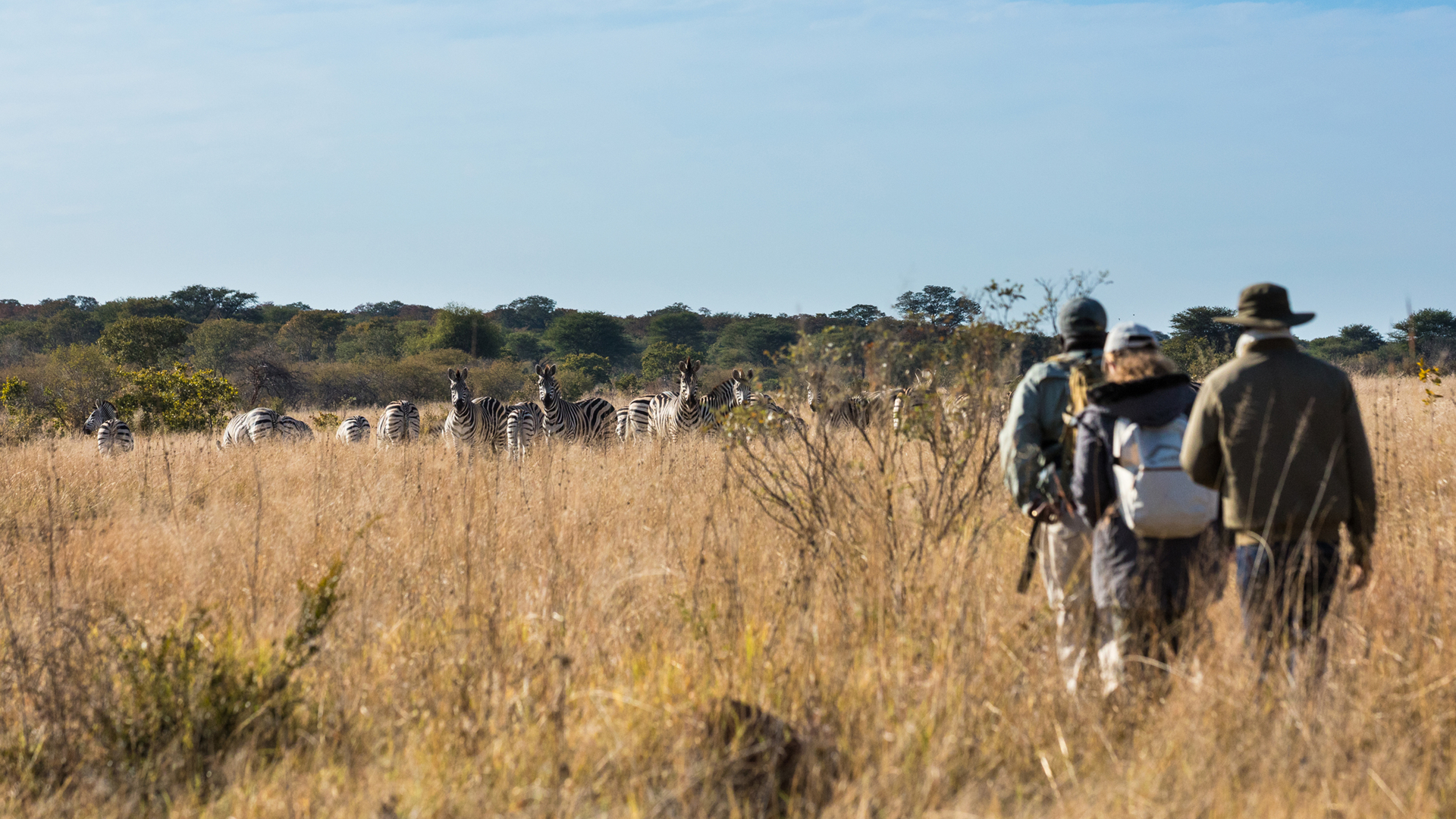
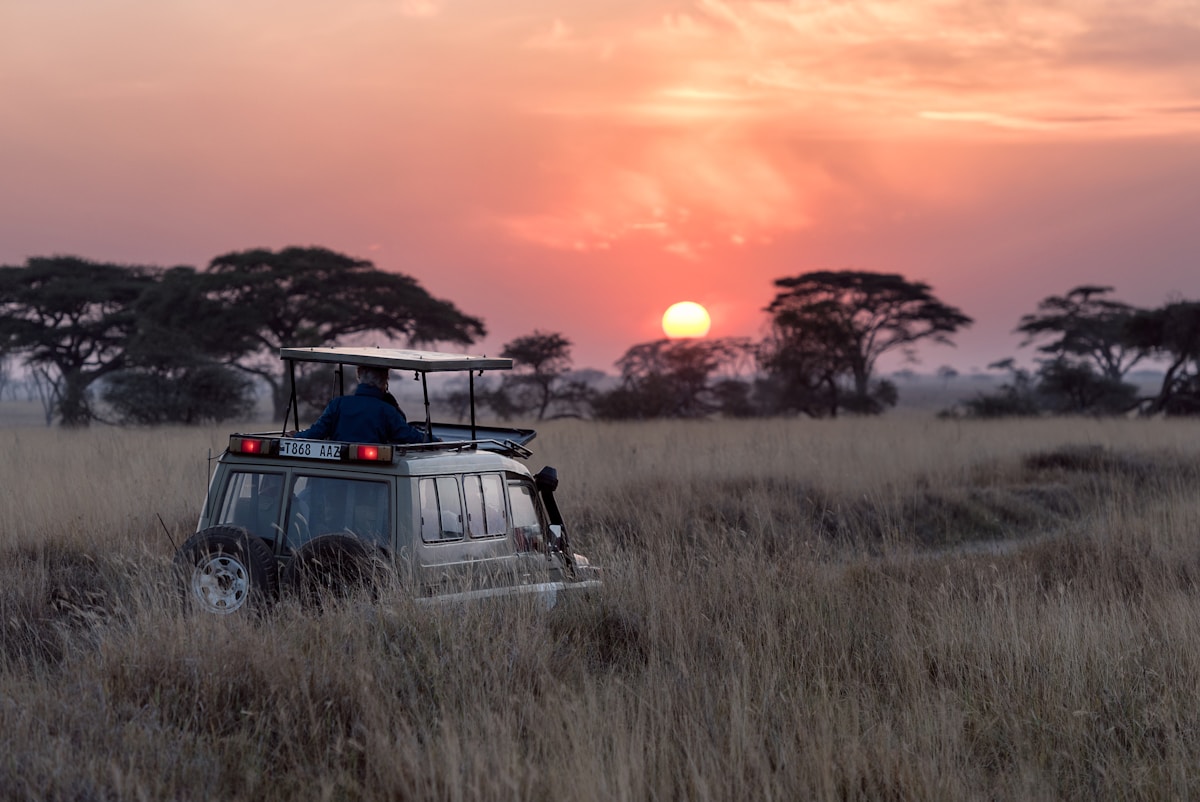
There is a moment, somewhere between the crunch of dry grass beneath your boots and the low rumble of an elephant feeding thirty metres away, when you understand why a walking safari in Hwange National Park is considered one of Africa's most profound wildlife experiences. Unlike the passive comfort of a game drive vehicle, a bush walk strips away every barrier between you and the wild. You read the landscape differently on foot , a pressed tuft of grass, a scuff in the dust, the faint musk of lion on the breeze. Hwange National Park, covering 14,651 square kilometres of northwestern Zimbabwe, offers some of the continent's finest walking safari terrain, with an extraordinary density of wildlife, expert professional guides, and a range of operators catering to every budget and fitness level. Whether you are a seasoned safari-goer or stepping into the African bush for the very first time, a walking safari here will almost certainly become the highlight of your entire trip.
What Is a Walking Safari in Hwange?
A walking safari , sometimes called a bush walk or foot safari , is a guided wildlife experience conducted entirely on foot, typically in the early morning or late afternoon when temperatures are cooler and animals are most active. In Hwange, walks generally last between two and four hours, covering distances of four to twelve kilometres depending on the operator, terrain, and pace set by the group. Multi-day fly-camping expeditions, where guests sleep under the stars at remote bush camps, can cover up to 60 kilometres over four to six days and represent the most immersive experience available in Zimbabwe.
Walking safaris differ fundamentally from game drives in Hwange in pace and intention. On a vehicle, the goal is often to cover ground and accumulate sightings. On foot, the experience slows dramatically. Your guide will pause to examine animal tracks, identify dung, explain the medicinal properties of a marula tree, or point out a banded mongoose colony that a vehicle would have driven straight past. The focus shifts from quantity of sightings to depth of understanding.
Walks are led by Zimbabwe Professional Guides Association (ZPGA) certified guides , some of the most rigorously trained wildlife professionals on the continent. A qualified Zimbabwe guide must complete a minimum of two years of field training and pass both written and practical examinations before being licensed to lead clients on foot in dangerous game country. For a broader overview of walking safaris across the country, see our guide to Walking Safaris in Zimbabwe: Getting Off the Vehicle and Into the Bush.
Key fact: Zimbabwe's professional guide qualification is widely regarded as the most demanding in Africa. A fully licensed guide (Level 1) must demonstrate competence in tracking, first aid, firearms handling, ecology, and client management before leading walks in areas with elephant, lion, leopard, buffalo, and rhinoceros.
Most operators in Hwange offer walking safaris as part of a broader safari package that also includes game drives, waterhole hides, and cultural experiences. Standalone walk bookings are available at several camps, typically priced between $45 and $150 per person for a half-day guided walk. For travellers watching their budget, our guide to Zimbabwe on a Budget includes practical advice on accessing walking experiences without overspending.
Safety Protocols: How Guides Keep You Protected
The most common question first-time walking safari guests ask is simple: Is it safe? The honest answer is that walking in dangerous game country carries inherent risk , but that risk is managed with exceptional professionalism by Zimbabwe's licensed guides. Understanding the safety protocols in place will help you feel confident and present during your walk rather than anxious.
Every walking safari in Hwange is led by at least one fully licensed professional guide carrying a high-calibre rifle , typically a .375 or .458 calibre , as a last resort in the event of a charge. Most operators also require a second armed guide or a tracker at the rear of the group. The standard group size is six to eight clients maximum, ensuring the guide maintains full situational awareness at all times.
Before every walk, guides conduct a thorough safety briefing covering the following:
- Walk in single file at all times and remain directly behind the lead guide.
- No talking unless the guide addresses you , sound travels far in the bush and alerts animals prematurely.
- Follow hand signals immediately and without question. A raised fist means freeze; a downward palm means crouch or sit.
- Never run if an animal is encountered , running triggers a predatory or defensive charge response.
- Stay downwind of target animals wherever possible; guides read wind direction constantly using fine dust or grass seeds.
- Switch off mobile phones or set to silent , a ringtone in the presence of a breeding herd of elephants is not an experience you want.
"I've been guiding on foot in Hwange for nineteen years. In all that time, I have never had to fire my rifle at an animal. Good guiding is about reading behaviour, understanding wind, and knowing when to back away quietly. The rifle is there for absolute emergencies , it is not the plan."
Important: Walking safaris are not suitable for children under 12 years of age at most operators, and some camps set the minimum age at 16 for walks in areas with high lion and elephant density. Always confirm age restrictions when booking.
Encounters with dangerous game are managed by approaching animals from downwind and at oblique angles, never head-on. Guides are trained to read body language in elephants (ear position, head height, temporal gland secretion), lions (tail flicks, crouching posture), and buffalo (head raising, pawing) to distinguish genuine threat from mock behaviour. In the vast majority of encounters, the guide will simply manoeuvre the group to a safe distance and allow the moment to unfold naturally.
Best Operators and Camps Offering Walking Safaris
Hwange has a well-developed network of camps and operators offering guided walking safaris, ranging from ultra-luxury lodges with private concessions to more accessible community-run operations. The quality of the walking experience depends enormously on the calibre of your guide and the exclusivity of the concession , a walk on a private 50,000-hectare concession with a single guide and two guests is a fundamentally different experience from a shared walk departing from a busy public camp.
Wilderness Safaris operates several camps in and around Hwange , including Linkwasha, Little Makalolo, and Davison's , all of which offer guided walks as part of their all-inclusive packages. Their guides are consistently rated among the best in Zimbabwe, and their concessions in the Linkwasha Exclusivity Zone provide access to some of the park's highest wildlife densities. Packages typically start from $750 per person per night all-inclusive.
The Hide Safari Camp, located on a private concession adjacent to the national park, has built its reputation on exceptional walking safaris and waterhole hides. Their half-day walks depart at 06:00 and 15:30 daily, led by guides with an average of twelve years' field experience. Rates start from approximately $95 per person for a standalone walk.
Camelthorn Lodge and Ivory Lodge, both situated near the Main Camp area, offer guided morning walks on the park boundary for guests staying on-site. These represent some of the more accessible entry points for walking safaris in Hwange, with walks included in lodge rates from $350–$550 per person per night.
For those combining a walking safari with a broader western Zimbabwe itinerary , perhaps including Victoria Falls or a detour through Matobo Hills , our Ultimate Safari Guide to Hwange National Park provides a comprehensive overview of camps, routes, and how to structure your time across the region.
Tip: Book walking safaris at least three to four months in advance for the peak dry season (June–October). The best guides and smallest group sizes fill up quickly, particularly at premium concessions. Use our Trip Planner to coordinate bookings across multiple activities and destinations.
| Operator / Camp | Walk Type | Duration | Group Size | Approx. Cost (USD) | Concession Type |
|---|---|---|---|---|---|
| Wilderness Safaris (Linkwasha / Davison's) | Half-day & fly-camp | 2–4 hrs / multi-day | Max 6 | Included from $750pp/night | Private exclusivity zone |
| The Hide Safari Camp | Half-day walk | 3–4 hrs | Max 8 | $95 standalone / included in lodge rate | Private concession |
| Camelthorn Lodge | Morning walk | 2–3 hrs | Max 8 | Included from $350pp/night | Park boundary / national park |
| Ivory Lodge | Morning walk | 2–3 hrs | Max 6 | Included from $420pp/night | Private concession |
| Zimbabwe Parks & Wildlife (Main Camp) | Guided park walk | 2–3 hrs | Max 10 | $45–$65 per person | National park (public) |
| Touch the Wild / Somalisa | Half-day & full day | 3–6 hrs | Max 6 | Included from $480pp/night | Private concession (Acacia Zone) |
Wildlife to Expect on a Hwange Bush Walk
Hwange National Park supports one of Africa's largest elephant populations , estimated at between 45,000 and 50,000 individuals , along with substantial populations of lion, leopard, wild dog, buffalo, and a recovering white rhinoceros population in the Sinamatella area. On a walking safari, the wildlife you encounter depends heavily on season, location within the park, and the skill of your tracker in reading the landscape.
Elephants are the species most frequently encountered on foot in Hwange, and approaching a breeding herd on foot , carefully, quietly, from downwind , is an experience of extraordinary emotional power. Your guide will typically bring the group within 30–60 metres of a relaxed herd before calling a halt, allowing you to observe natural behaviours , calves playing, matriarchs directing movement, bulls testing the air , that are simply invisible from a vehicle at greater distance.
Buffalo are encountered regularly on walks in the dry season, particularly near the park's famous waterholes. For a detailed guide to Hwange's best waterhole locations and what wildlife congregates there, see our article on Hwange's Best Waterholes: Where to Watch Africa's Greatest Wildlife Spectacle. Buffalo are considered one of the most dangerous animals to encounter on foot, and guides will always maintain a clear retreat route when in their vicinity.
Lion sightings on foot are less predictable but more common than many guests expect, particularly in the Linkwasha and Kennedy Vlei areas where prides are well-habituated to human presence. Leopard, being largely nocturnal and highly secretive, are rarely seen on morning walks but tracks and scratch marks on trees are frequently identified by trackers. African wild dog , one of the continent's most endangered predators, with Hwange hosting one of the largest remaining populations , are occasionally encountered on walks near denning sites between June and September.
Beyond the headline species, walking safaris reveal a world of smaller wildlife that transforms the experience: ground hornbills striding through the grass, dwarf mongooses tumbling over termite mounds, white-backed vultures circling a distant kill, the geometric precision of a dung beetle rolling its prize across the path. For dedicated birders, Hwange's walking terrain is exceptional , the park records over 420 bird species, many of which are best observed on foot. Our guide to Bird Watching in Western Zimbabwe covers the top species and locations in detail.
"We spent forty minutes watching a pride of seven lions from about forty metres , two males, three females, and two cubs. On a game drive you'd have ticked the box and moved on. On foot, you stay still, you breathe slowly, and you watch them live. It changed how I think about wildlife completely."
Wildlife density note: The Linkwasha Exclusivity Zone in the southern section of Hwange consistently records the highest wildlife densities for walking safaris. The Sinamatella area in the northwest offers the best chance of encountering white rhinoceros on foot, though this requires advance arrangement with Zimbabwe Parks & Wildlife Management Authority.
Tracking is an integral part of the walking safari experience in Hwange. Zimbabwe's trackers , many from the local Tsholotsho community with generations of bush knowledge , can identify species, approximate age and sex, and estimate the time elapsed since an animal passed from a single footprint in the dust. Watching a skilled tracker work is itself a highlight, and many guests find this interpretive dimension of walking safaris as rewarding as the animal encounters themselves.
, Article continues in Part 2, covering fitness requirements and what to bring, the best season for walking safaris, photography tips on foot, and a full operator comparison table ,
What to Wear and Bring on a Walking Safari in Hwange
Packing correctly for a walking safari in Hwange is not merely about comfort , it can genuinely affect your safety and the quality of your experience. Unlike a vehicle-based game drive, where you can stash a bag beneath your seat, on foot you carry only what fits in a small daypack. Every item must earn its place.
Colour is the first consideration. Guides are emphatic on this point: avoid white, bright blue, red, or any vivid pattern. Neutral tones , khaki, olive green, stone, and tan , blend into the dry woodland palette of Hwange's mopane and teak scrub. Dark navy is acceptable but black absorbs heat uncomfortably in temperatures that regularly exceed 35°C in October. Many experienced walkers choose lightweight long-sleeved shirts in these tones to guard against both sun and acacia thorns.
Footwear deserves particular attention. Ankle-supporting boots with a sturdy sole are strongly recommended , not trail runners, which offer insufficient protection against thorns, rocky ground, and the occasional scorpion. Break your boots in thoroughly before your trip; blisters on a walking safari are miserable and potentially walk-ending. Merino wool socks help manage moisture and reduce rubbing.
For photography, keep your camera accessible but secured. A chest harness or small shoulder bag works far better than a backpack-mounted camera, where fumbling for equipment at a critical moment can disturb both the animals and your guide's concentration. For detailed advice on capturing images whilst on foot, read our guide to 12 Wildlife Photography Tips for Your Zimbabwe Safari.
Insider Tip: Apply insect repellent before dressing, not after , spraying directly onto clothing rather than skin reduces absorption and lasts longer in the heat. A buff or lightweight scarf doubles as dust protection and sun cover for your neck.
| Category | Essential Items | Useful but Optional |
|---|---|---|
| Clothing | Neutral-tone long-sleeve shirt, lightweight trousers, wide-brim hat | Fleece layer (cool mornings), convertible zip-off trousers |
| Footwear | Ankle-support hiking boots (broken in), wool socks x2 | Camp sandals for evenings |
| Health & Safety | High-factor sunscreen (SPF 50+), DEET insect repellent, personal medication, lip balm | Blister plasters, antihistamine cream |
| Hydration & Nutrition | Reusable water bottle (minimum 1.5 litres), energy snacks | Electrolyte tablets, trail mix |
| Optics & Tech | Binoculars (8x42 recommended), camera with silent mode enabled | Telephoto lens, spare battery, lens cloth |
| Miscellaneous | Small daypack (20–25 litre), buff/scarf, sunglasses | Field guide to mammals or birds, notebook |
Best Season for Walking Safaris in Hwange
Timing your walking safari correctly transforms a good experience into an extraordinary one. Hwange's seasons divide broadly into a wet season (November to April) and a dry season (May to October), and the two offer markedly different walking conditions.
The dry season , particularly June through October , is widely regarded as the prime walking safari period. As waterholes shrink and surface water becomes scarce, wildlife concentrates around Hwange's famous pumped pans. Walking towards a waterhole at dawn and finding elephant herds, buffalo, and zebra gathered together is a genuinely humbling experience. Vegetation thins out as the season progresses, improving visibility through the mopane scrub. Temperatures in June and July are mild (18–25°C during the day), making walking physically comfortable. By September and October, heat intensifies sharply , walks begin as early as 5:30am to avoid the worst of it, but wildlife sightings reach their annual peak.
The wet season brings lush green landscapes and dramatic thunderstorms, but walking becomes more challenging. Tall grass reduces visibility significantly, and many camps reduce or suspend walking programmes. That said, December through February is excellent for birdlife, as migratory species arrive in force. If birding is your primary motivation, the wet season has genuine merit , pair your visit with our Bird Watching in Western Zimbabwe guide for species lists and waterhole locations.
Best Months at a Glance: September and October offer the most dramatic wildlife concentrations around waterholes but are extremely hot. June and July provide comfortable walking temperatures with excellent game viewing. August sits in the sweet spot , warm, dry, and busy with wildlife. Avoid January and February for walking safaris unless birding is the priority.
If you're combining your Hwange walking safari with a visit to Victoria Falls, note that the falls are at their most dramatic from March to May. Planning both in the same trip requires some seasonal compromise , our month-by-month Victoria Falls guide helps you weigh up the options carefully.
Booking well in advance is essential for the peak July-to-October window. The best walking safari camps , Somalisa, Little Makalolo, and Wilderness Safaris' Davison's Camp , fill up 9 to 12 months ahead for the dry season. Contact operators early or use our Trip Planner to check availability across multiple camps simultaneously.
Photography Tips Specific to Walking Safaris
Photographing wildlife on foot presents a completely different set of challenges compared to shooting from a raised game drive vehicle. The angles are lower, the distances are often closer, and the need for silence and stillness is absolute. Master these constraints and you will return home with images that stand apart from anything captured from a Land Cruiser.
Silence mode on your camera is non-negotiable. The mechanical shutter click of a DSLR carries surprisingly far in quiet bush, and at close range it can startle animals or irritate your guide. Switch to electronic shutter where your camera supports it, and disable any sounds or notifications on your phone entirely before the walk begins.
Lens choice matters enormously. A versatile 100–400mm zoom gives you reach for distant subjects whilst allowing you to pull back for environmental portraits when animals are close. Prime lenses, though optically superior, limit your flexibility in situations that change rapidly. A 70–200mm f/2.8 is an excellent compromise , fast enough for low-light dawn starts, long enough for reasonable reach.
Composition on foot allows for something vehicle-based photography rarely achieves: genuine eye-level shots. When your guide signals a stop and you crouch slowly, you can photograph a bull elephant at the same horizontal plane , an intimate perspective that conveys scale and presence far more powerfully than a downward angle. Practice crouching quietly and steadily before your trip.
Pro Tip: Shoot in short bursts rather than holding down the shutter continuously. Continuous shooting creates noise and vibration. Two or three frames at the decisive moment, selected carefully, will outperform fifty mediocre shots every time. For a full breakdown of techniques, see our Zimbabwe Safari Photography Guide.
Golden hour on a walking safari is extraordinary. The low morning light filtering through Hwange's teak and mopane woodland creates a warmth that midday light simply cannot replicate. Arrive at your waterhole position before sunrise if your guide permits, set your exposure manually to preserve the amber tones, and shoot slightly underexposed , you can recover shadows in post-processing far more easily than blown highlights on a pale elephant hide.
Budget Breakdown: What a Walking Safari in Hwange Really Costs
Walking safaris in Hwange span a wide price spectrum, from budget-conscious options at community-run camps to ultra-luxury fly-in experiences with private guides. Understanding what drives the cost helps you make an informed decision rather than simply defaulting to the cheapest or most expensive option.
The primary cost driver is accommodation. Walking safari activities themselves are often included in full-board lodge rates, meaning the nightly rate covers your accommodation, all meals, game drives, and guided walks. Budget-tier camps in the Hwange area charge from around $150 to $250 per person per night all-inclusive. Mid-range options , typically owner-operated camps with experienced guides , run from $350 to $600 per night. Premium and ultra-luxury camps, including those operated by Wilderness Safaris and &Beyond, range from $800 to over $2,000 per person per night.
For travellers seeking to experience Hwange without the premium lodge price tag, our guide to Zimbabwe on a Budget outlines realistic alternatives, including self-catering options near the park boundary and community campsites that offer guided walks at significantly reduced rates. You might also consider supplementing a shorter luxury stay with a self-drive safari in Hwange to extend your time in the park affordably.
Important: Very low-cost "walking safari" offerings (under $50 per person) in the wider Victoria Falls area are generally not conducted inside Hwange National Park and may involve habituated or captive animals. Always confirm that your walk takes place within the national park boundary with a licensed professional guide.
| Budget Tier | Typical Nightly Rate (Per Person) | What's Included | Example Operators | Best For |
|---|---|---|---|---|
| Budget | $150–$250 | Accommodation, meals, guided walks (park fees sometimes extra) | Community-run camps, Hwange Safari Lodge walking add-ons | Cost-conscious travellers, backpackers extending a Zim trip |
| Mid-Range | $350–$600 | Full board, guided walks, game drives, laundry | Camelthorn Lodge, Ivory Lodge, Touch the Wild | Couples, small groups, experienced safari-goers |
| Premium | $800–$1,400 | All-inclusive, private guides, transfers, conservation fees | Somalisa Camp, Little Makalolo, Davison's Camp | Honeymoons, once-in-a-lifetime trips, serious wildlife enthusiasts |
| Ultra-Luxury | $1,500–$2,500+ | Private vehicle, exclusive guiding, fly-in transfers, premium bar | Wilderness Safaris exclusive camps, private concession camps | Discerning travellers, private groups, photography specialists |
Park entry fees for Hwange National Park are charged separately at most camps and currently stand at approximately $20 per person per day for international visitors. These fees directly support anti-poaching operations and habitat management , to understand more about how your tourism spend contributes to conservation, read our piece on conservation and community in Western Zimbabwe.
When budgeting for a broader western Zimbabwe itinerary, factor in transfers between Hwange and Victoria Falls (road transfer approximately $50–$80 per person, light aircraft $180–$250 one way). Many travellers combine a two-to-three night walking safari in Hwange with activities at the falls , consider Sunset Cruises on the Zambezi or the adrenaline of White Water Rafting as complementary experiences that round out a western Zimbabwe adventure.
Final Thoughts
A walking safari in Hwange National Park is one of the most rewarding wildlife experiences available anywhere in Africa. It strips away the vehicle, the elevated seat, and the comfortable distance, placing you directly into the sensory world of the African bush , the crunch of dry leaves underfoot, the sharp scent of elephant dung, the electric stillness when your guide raises a fist and everything stops.
It demands a degree of physical fitness, a willingness to follow instructions precisely, and an acceptance that the bush operates on its own schedule. In return, it offers encounters and perspectives that no game drive can replicate. Standing seventy metres from a breeding herd of elephant, watching them move through golden morning light whilst your guide whispers the matriarch's history , that is the kind of moment that reorients your understanding of the natural world.
Hwange's walking safari operators are among the most experienced in Zimbabwe, working within a park that holds one of Africa's largest elephant populations alongside lion, leopard, wild dog, and an extraordinary diversity of birdlife. Whether you choose a premium fly-in camp or a more modest community-run experience, the fundamentals remain the same: a qualified guide, a loaded rifle carried only as a last resort, and an ancient landscape that has been walked by humans and wildlife for millennia.
Use our Trip Planner to build your ideal Hwange itinerary, browse the Business Directory for vetted operators, or visit our Travel Advice section for up-to-date entry requirements and health recommendations. If you have specific questions about walking safari options, our team is always happy to help , Contact Us directly for personalised recommendations.
For those looking to extend their western Zimbabwe adventure beyond Hwange, consider the dramatic landscapes of Matobo Hills, the waterside calm of Binga on Lake Kariba, or the full sweep of the region covered in our Great Western Zimbabwe Road Trip guide. This corner of Africa rewards slow, curious travel , and there is no slower, more curious way to experience it than on foot.
Frequently Asked Questions
Is a walking safari in Hwange safe?
Yes, when conducted by a licensed professional guide carrying a high-calibre rifle, walking safaris in Hwange are considered safe. Guides undergo rigorous training and follow strict protocols for approaching and retreating from wildlife. Incidents are extremely rare. The key is choosing an operator who employs fully qualified, experienced guides and following all instructions precisely throughout the walk.
How fit do I need to be for a walking safari in Hwange?
A reasonable level of fitness is required, but you do not need to be an athlete. Most guided walks cover between 5 and 12 kilometres over two to three hours at a gentle pace with frequent stops. The terrain is relatively flat. If you can walk comfortably for two hours on uneven ground, you are fit enough. Inform your operator of any medical conditions or mobility concerns before booking.
What is the best time of year for a walking safari in Hwange?
The dry season from June to October is the best period for walking safaris in Hwange. Wildlife concentrates around waterholes as surface water diminishes, improving sighting frequency dramatically. June and July offer comfortable walking temperatures (18–25°C), while September and October deliver peak wildlife concentrations despite intense heat. Walks begin very early , often at 5:30am , during the hotter months to avoid midday temperatures.
What should I wear on a walking safari in Hwange?
Wear neutral-coloured clothing in khaki, olive, stone, or tan. Avoid white, bright colours, and strong patterns. Long-sleeved shirts and lightweight trousers protect against sun and thorns. Sturdy ankle-support hiking boots , properly broken in before your trip , are essential. A wide-brimmed hat, sunglasses, and a buff or scarf for neck protection complete the basics. Leave strong perfumes and aftershave behind entirely.
How much does a walking safari in Hwange cost?
Costs vary considerably by camp tier. Budget options at community camps start from around $150 per person per night all-inclusive. Mid-range owner-operated camps charge $350 to $600 per night, while premium operators such as Wilderness Safaris and &Beyond range from $800 to over $2,000 per night. Park entry fees of approximately $20 per person per day are often charged separately. Walking activities are typically included in full-board lodge rates.
Can I see the Big Five on a walking safari in Hwange?
Elephant, buffalo, and lion are regularly encountered on foot in Hwange, and leopard sightings , whilst always unpredictable , do occur. Rhino are not currently present in Hwange in significant numbers, making a true Big Five walking experience difficult to guarantee. However, the quality of elephant and predator encounters on foot in Hwange frequently surpasses equivalent vehicle-based sightings in terms of intimacy, proximity, and lasting impression.